
Average Dwell Time by Industry 2026: Shocking Trends
The Average Dwell Time by Industry 2026 reveals a concerning security gap across major sectors.
Dwell time measures how long attackers remain inside a network before being detected. The longer they stay undetected, the greater the financial damage, operational disruption, and regulatory exposure.
In 2026, dwell time varies significantly between healthcare, financial services, and government organizations. These differences highlight detection maturity gaps that demand executive attention.
Understanding these benchmarks helps CISOs and security leaders evaluate whether their organization is ahead — or dangerously behind.
Table of Contents
What Is Dwell Time?
Dwell time refers to the number of days between initial compromise and detection.
It directly affects:
- Breach severity
- Data theft volume
- Ransomware spread
- Compliance reporting risk
- Total incident cost
Reducing dwell time reduces impact.
👉 Learn more about dwell time fundamentals:
Dwell time is closely connected to:
- Mean Time to Detect (MTTD)
- Mean Time to Respond (MTTR)
👉 MTTD Guide: Mean Time to Detect (MTTD)
👉 MTTR Guide: Mean Time to Respond (MTTR)
Why 2026 Industry Benchmarks Matter
The Average Dwell Time by Industry 2026 differs due to:
- Monitoring maturity
- Security investment levels
- Regulatory pressure
- Infrastructure complexity
- Cloud adoption
Reports from IBM and Mandiant continue to highlight industry variation.
Benchmarking against sector averages allows organizations to identify detection performance gaps.
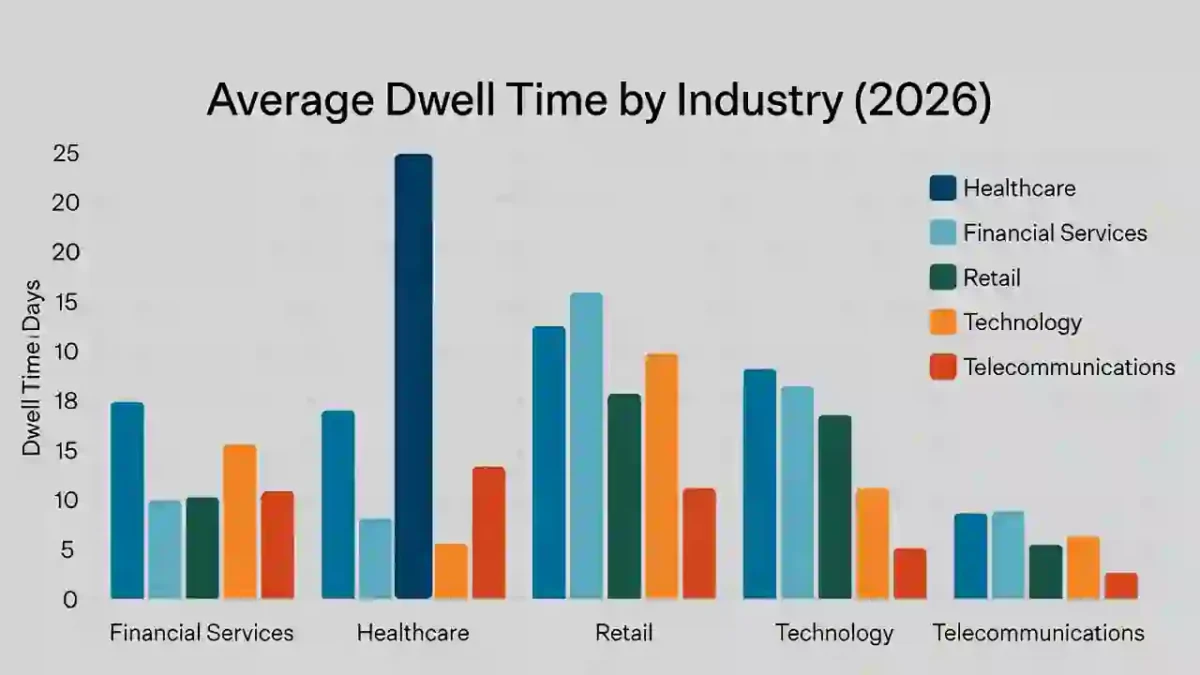
Healthcare Dwell Time in 2026
Estimated Average: 18–22 Days
Healthcare continues to show higher dwell time averages.
Reasons include:
- Legacy medical systems
- Limited segmentation
- High phishing exposure
- Operational constraints during patient care
Ransomware remains dominant in healthcare. Attackers often move laterally for days before encryption.
Detection delays in this sector can directly affect patient safety.
Financial Services Dwell Time in 2026
Estimated Average: 10–14 Days
Financial institutions typically maintain lower dwell times.
Contributing factors:
- Advanced behavioral analytics
- Continuous monitoring
- Regulatory pressure
- Mature security operations centers
Banks invest heavily in early detection tools.
However, cloud-based and API-driven attacks are increasing in complexity.
Even short dwell time can result in significant data exposure.
Government Sector Dwell Time in 2026
Estimated Average: 16–20 Days
Government agencies show uneven detection maturity.
Federal agencies demonstrate improved monitoring, while local and municipal agencies may struggle with:
- Budget constraints
- Aging infrastructure
- Limited SOC staffing
Advanced persistent threats frequently target government networks.
Detection improvement efforts are ongoing, but exposure gaps remain.
What Drives Industry Differences?
Several core factors influence dwell time:
1. Monitoring Maturity
Organizations with 24/7 SOC operations detect threats faster.
2. Network Segmentation
Segmented environments limit lateral movement.
👉 Network segmentation best practices
3. Automation and AI
Automated alert triage reduces investigation delays.
4. Incident Response Readiness
Lower MTTR improves containment speed.
2026 Dwell Time Comparison
| Industry | Estimated Average Dwell Time |
|---|---|
| Healthcare | 18–22 Days |
| Finance | 10–14 Days |
| Government | 16–20 Days |
Some advanced ransomware campaigns now complete lateral movement within 72 hours.
That makes early detection critical.
How to Reduce Dwell Time in 2026
Organizations can reduce dwell time by:
- Deploying endpoint detection and response tools
- Enforcing multi-factor authentication
- Conducting proactive threat hunting
- Improving log visibility
- Automating containment workflows
- Testing incident response plans
Reducing dwell time also strengthens compliance positioning under regulations such as:
👉 SEC Cyber Rule Timeline 2026:
Final Thoughts
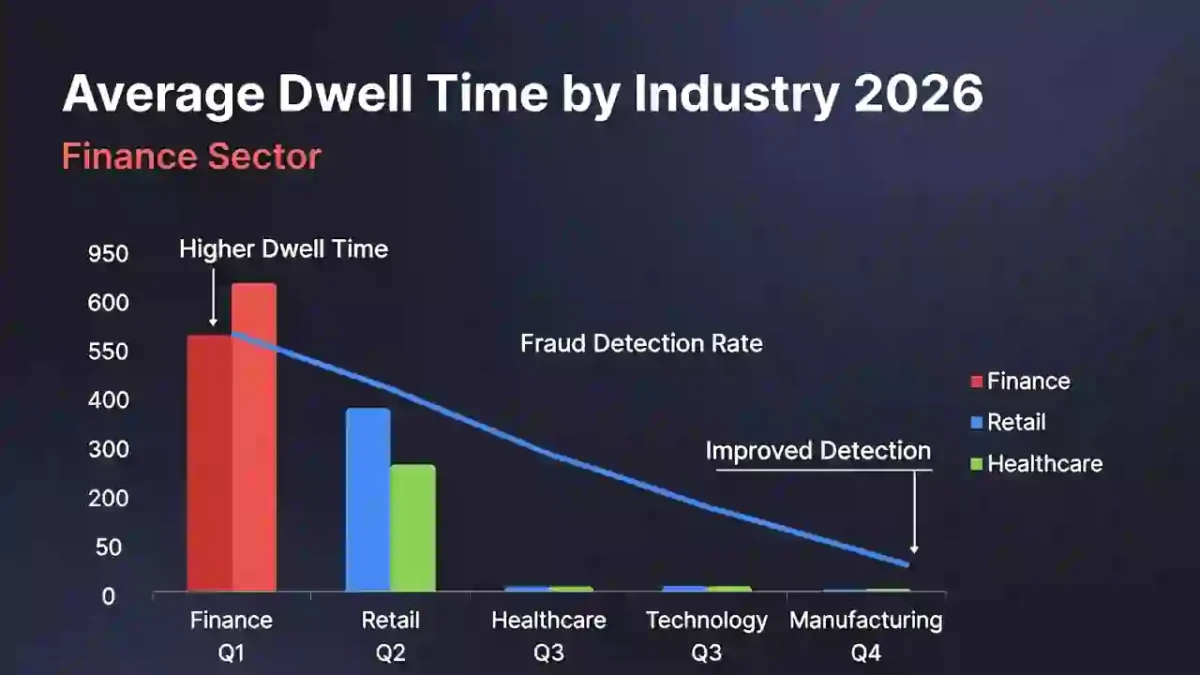
The Average Dwell Time by Industry 2026 reveals significant detection disparities across healthcare, finance, and government sectors.
Healthcare remains highly exposed.
Finance maintains faster detection.
Government shows uneven maturity.
In 2026, dwell time is not just a technical metric — it is a strategic risk indicator.
Reducing it should be a board-level priority for every organization.