
Mean Time to Contain (MTTC): Definition, Formula, and Proven Reduction Strategies
Mean Time to Contain (MTTC) is a cybersecurity metric that measures how long it takes to stop a detected security incident from spreading further within an organization.
Detection alone does not prevent damage. What matters is how quickly containment actions are executed.
As modern attacks target endpoints, cloud systems, identities, and SaaS environments simultaneously, Mean Time to Contain (MTTC) has become one of the most important indicators of security operations maturity.
Table of Contents
1. What Is Mean Time to Contain (MTTC)?
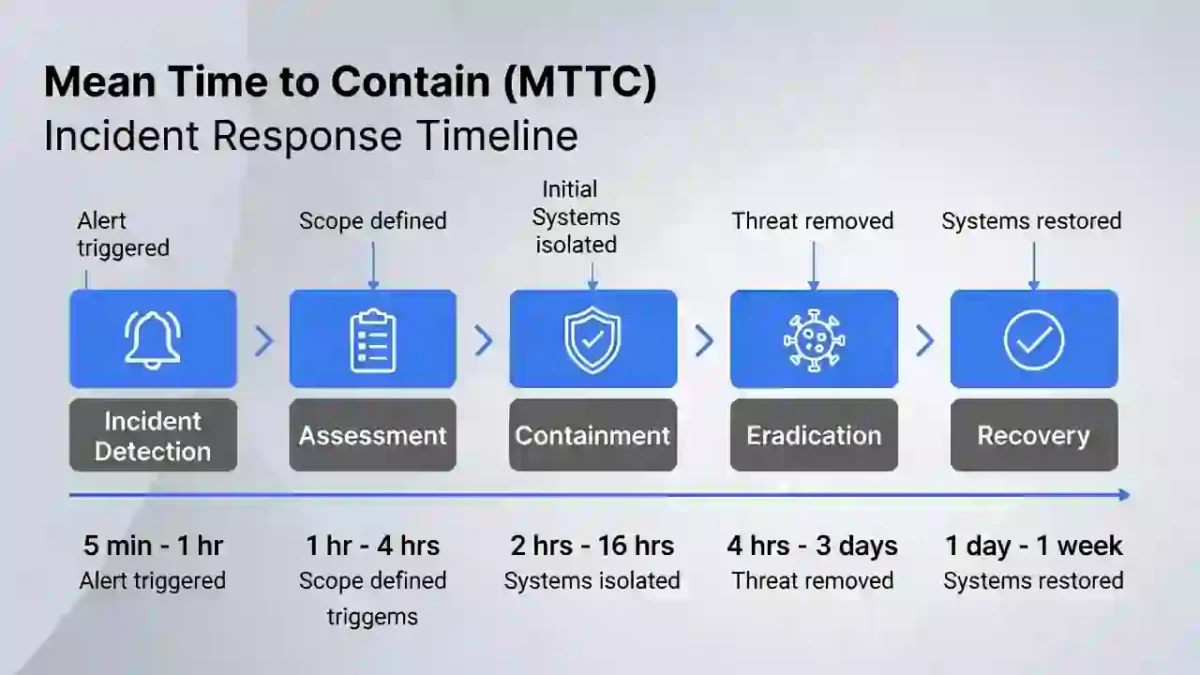
Mean Time to Contain (MTTC) is the average time between the detection of a cybersecurity incident and the moment the organization successfully limits further impact.
Containment focuses on stopping damage — not full recovery.
In practical terms, MTTC measures how quickly teams can:
✓ Isolate compromised systems
✓ Disable affected user accounts
✓ Block malicious IP addresses or domains
✓ Prevent lateral movement
Definition:
Mean Time to Contain (MTTC) is the average duration from incident detection to effective limitation of further harm.
This definition aligns with the incident response lifecycle defined by:
• ISO/IEC 27035 (Information Security Incident Management)
2. Why Mean Time to Contain (MTTC) Matters
Cyberattacks escalate quickly once initial access is obtained.
Attackers often attempt to:
• Escalate privileges
• Move laterally
• Deploy ransomware
• Exfiltrate sensitive data
A long Mean Time to Contain (MTTC) increases:
→ Financial losses
→ Operational downtime
→ Regulatory penalties
→ Brand damage
A shorter MTTC reduces blast radius — even if detection was delayed.
If you want to understand the detection phase in detail, see:
Mean Time to Detect (MTTD) Guide
3. MTTC vs MTTD vs MTTR
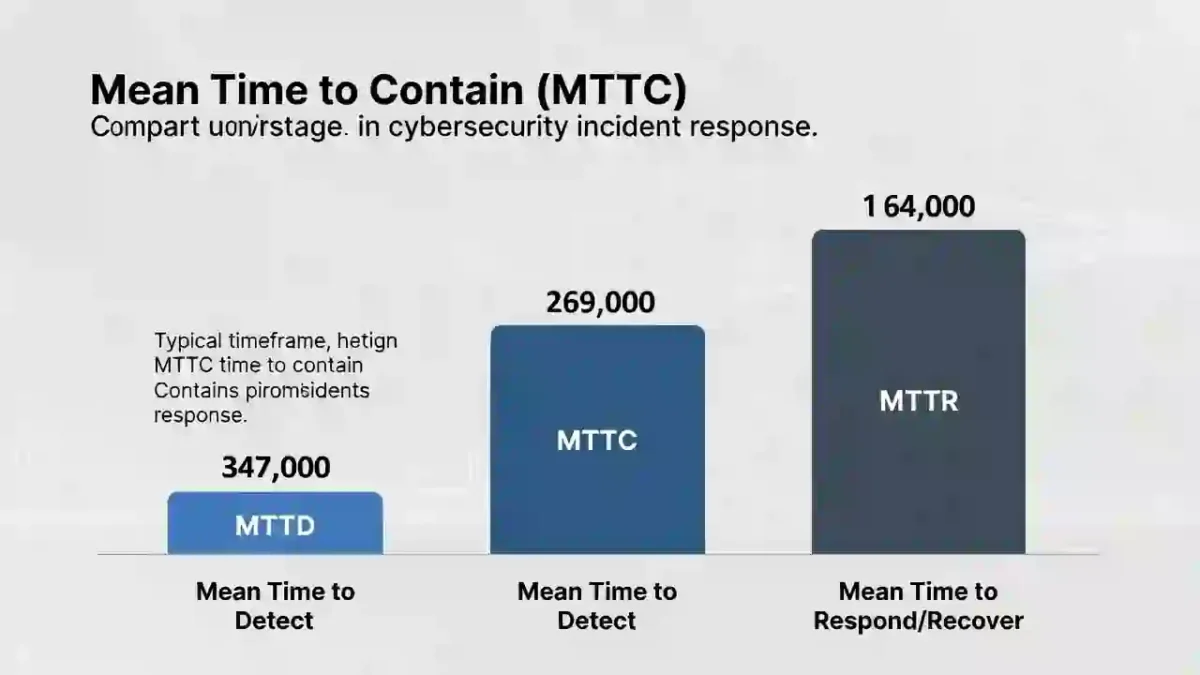
These three metrics measure different phases of incident response.
| Metric | Measures |
|---|---|
| MTTD | Time to detect an incident |
| MTTC | Time to contain and limit spread |
| MTTR | Time to remediate and recover |
Incident lifecycle:
Detection → Containment → Recovery
To complete the metrics triangle, also review:
Mean Time to Respond (MTTR) Explained
4. What Containment Means in Incident Response
Containment includes actions that prevent further compromise.
Examples of containment actions:
✓ Endpoint isolation via EDR
✓ Account disablement
✓ Token or session revocation
✓ Network segmentation
✓ Blocking malicious traffic
✓ Email quarantine
Containment does NOT include:
✗ System rebuilds
✗ Long-term remediation
✗ Root-cause documentation
According to AWS Security Incident Response guidance Containment focuses on limiting impact before eradication and recovery.
5. How to Calculate Mean Time to Contain (MTTC)
Formula:
MTTC = ∑ Containment Time ÷ Number of Incidents
Example:
If 4 incidents required a total of 16 hours to contain:
MTTC = 16 ÷ 4 = 4 hours
Measurement guidelines:
• Start time → When alert is confirmed
• End time → When spread is successfully stopped
For official lifecycle reference, review:
NIST Incident Response Lifecycle
6. What Is a Good Mean Time to Contain (MTTC)?
There is no universal benchmark.
Acceptable MTTC depends on:
• Organization size
• Infrastructure complexity
• SOC maturity
• Severity of incidents
• Tooling integration
Instead of comparing to industry averages, focus on:
✓ Continuous reduction
✓ Faster containment for high-risk scenarios
Trend improvement matters more than comparison.
7. International Standards Related to MTTC
Mean Time to Contain (MTTC) aligns with:
• NIST SP 800-61 – Incident Handling Guide
• ISO/IEC 27035 – Incident Management Standard
Both emphasize rapid containment as a primary objective before eradication and recovery.
These standards support structured containment workflows and predefined authority models.
8. 10 Proven Ways to Reduce Mean Time to Contain (MTTC)
1 → Predefine containment authority
Eliminate approval delays.
2 → Enable rapid endpoint isolation
One-click isolation reduces MTTC immediately.
3 → Strengthen identity controls
Revoke sessions and reset credentials quickly.
4 → Implement network segmentation
Segmentation limits lateral spread.
5 → Automate early response actions
SOAR automation reduces manual delays.
6 → Maintain accurate asset visibility
You cannot isolate unknown systems.
7 → Conduct regular containment exercises
Practice improves speed.
8 → Reduce alert fatigue
Improve signal-to-noise ratio.
9 → Define severity-based playbooks
Clear rules shorten decision time.
10 → Measure MTTC consistently
What is measured improves.
9. Real-World Examples
Ransomware Attempt
Containment steps:
→ Isolate infected endpoint
→ Disable compromised credentials
→ Block malicious indicators
Cloud Account Compromise
Containment steps:
→ Reset password
→ Revoke active tokens
→ Review permissions
Phishing Campaign
Containment steps:
→ Quarantine emails
→ Block sender domain
→ Isolate affected users
10. Frequently Asked Questions
Is Mean Time to Contain (MTTC) the same as MTTR?
No. MTTC measures how fast damage is limited. MTTR measures full recovery.
Does MTTC include detection time?
Typically no. It begins after detection.
Why is MTTC critical in cloud environments?
Because cloud incidents can scale across accounts and services rapidly.
11. Final Thoughts
Mean Time to Contain (MTTC) is a foundational cybersecurity metric.
Organizations that reduce MTTC:
✓ Minimize breach impact
✓ Reduce operational disruption
✓ Improve regulatory compliance
✓ Demonstrate security maturity
Detection identifies the threat.
Containment limits the damage.
For modern cybersecurity programs, optimizing Mean Time to Contain (MTTC) is essential.