
SOC Efficiency Metrics 2026: 7 Critical Benchmarks
Security Operations Centers are under more pressure than ever in 2026.
Alert volumes are increasing. Regulatory deadlines are tightening. Executive oversight is expanding. Measuring SOC Efficiency Metrics 2026 is no longer optional — it is essential for operational resilience and compliance readiness.
Modern organizations must track the right performance indicators to reduce dwell time, improve detection speed, and strengthen incident response outcomes.
This guide outlines the seven most critical SOC efficiency benchmarks for 2026.
Table of Contents
Why SOC Efficiency Metrics 2026 Matter More Than Ever
The role of the SOC has evolved dramatically.
It is no longer just a monitoring function. It is now the first line of defense against ransomware, insider threats, supply chain compromise, and regulatory failure.
Delayed detection can directly impact:
- SEC 4-day reporting windows
- CIRCIA 72-hour notification rules
- UK ICO breach deadlines
- Cyber insurance claims
In this environment, efficiency equals risk reduction.
Tracking structured SOC Efficiency Metrics 2026 ensures that detection and response operations remain measurable, defensible, and continuously improving.
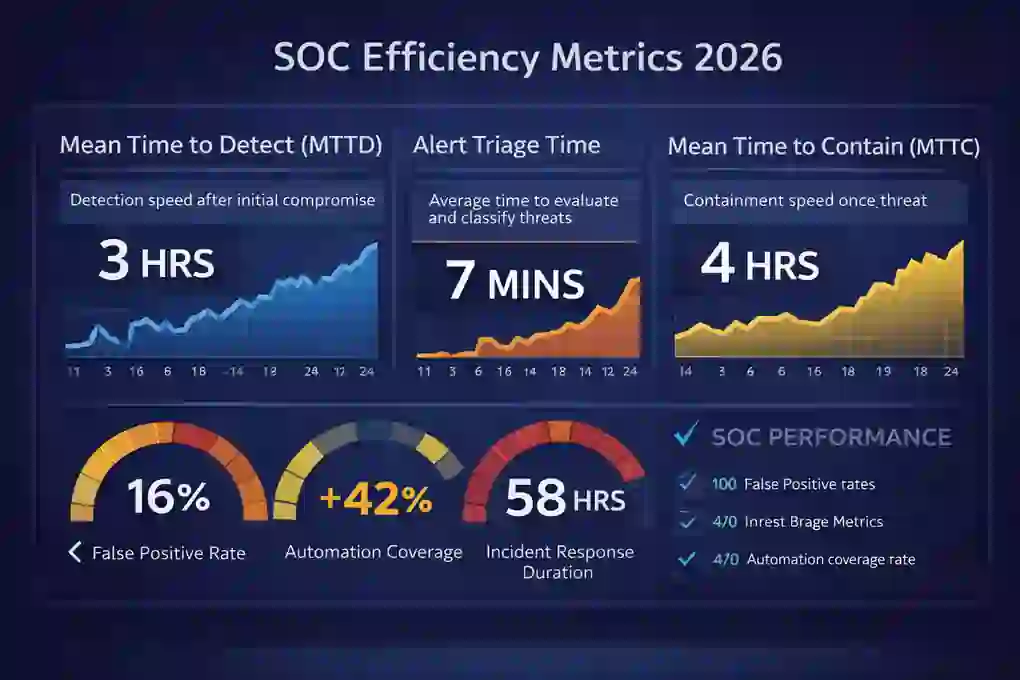
1️⃣ Mean Time to Detect (MTTD)
Detection speed remains the foundation of SOC performance.
MTTD measures how quickly threats are identified after initial compromise. Lower MTTD reduces lateral movement, data exfiltration risk, and compliance exposure.
Organizations that reduce detection time typically experience lower breach costs and shorter recovery cycles.
👉 Internal resource: Mean Time to Detect (MTTD)
Alert triage time measures how quickly analysts review and classify security alerts.
If triage queues grow too large, detection bottlenecks develop. This increases dwell time and response delays.
Key indicators to monitor:
- Average triage duration
- Alert backlog volume
- Escalation speed
Automation and AI-assisted analysis are increasingly critical for improving triage efficiency in 2026.
3️⃣ Mean Time to Contain (MTTC)
Mean Time to Contain (MTTC)
Containment speed reflects how quickly threats are isolated once identified.
Short containment windows reduce operational disruption and financial loss.
👉 Related benchmark: Average Ransomware Containment Time 2026
In high-performing SOC environments, containment processes are automated wherever possible.
4️⃣ Dwell Time
Dwell time measures how long attackers remain undetected in an environment.
Extended dwell time often correlates with higher breach severity.
👉 Comparison guide: Dwell Time vs MTTD
Reducing dwell time is one of the clearest indicators of improving SOC maturity.
5️⃣ False Positive Rate
High false positive rates create analyst fatigue and reduce productivity.
Monitoring:
- Percentage of false alerts
- Alert quality scoring
- Signal-to-noise ratio
Improves SOC focus and operational accuracy.
6️⃣ Automation Coverage Rate
SOC automation coverage measures how many repetitive tasks are handled by SOAR platforms or AI-driven workflows.
Higher automation coverage:
- Reduces triage delays
- Improves containment speed
- Supports regulatory documentation
According to NIST incident response guidance:
Reference (NIST Incident Response Framework)
Structured response processes significantly improve incident outcomes.
7️⃣ Incident Response Completion Time
This metric tracks full lifecycle resolution — from detection through recovery.
Boards and executives increasingly request visibility into total response duration, not just detection speed.
👉 Governance context: Board-Level Cybersecurity Metrics Guide
Tracking trend improvements in response completion strengthens executive confidence.
Regulatory & Executive Pressure in 2026
SOC teams now operate under increased governance scrutiny.
Detection delays can directly impact:
- Disclosure deadlines
- Regulatory penalties
- Insurance investigations
- Board oversight reviews
This makes SOC Efficiency Metrics 2026 a governance-level topic — not just an operational one.
Organizations that track efficiency metrics quarterly are better positioned to defend their response timelines during audits or investigations.
Final Thoughts
Measuring SOC Efficiency Metrics 2026 enables organizations to:
- Reduce detection gaps
- Shorten dwell time
- Accelerate containment
- Improve analyst productivity
- Strengthen regulatory compliance
In 2026, SOC efficiency defines organizational resilience.
Performance must be measurable, continuously optimized, and aligned with enterprise risk management objectives.