
UK Cyber Resilience Bill Explained: 7 Critical Changes
A practical UK Cyber Resilience Bill Explained guide matters because this is now a live legislative issue, not a vague policy idea. The Cyber Security and Resilience (Network and Information Systems) Bill was introduced in the House of Commons on 12 November 2025, and the UK Parliament stages page currently shows report stage: date to be announced. The government says the bill will reform and add to the existing Network and Information Systems Regulations 2018 rather than replace the whole framework.
For many organisations, the real question is simple: does this bill affect us, and what should we do now?
This article explains the bill in plain English. It focuses on scope, reporting, supplier exposure, governance, and the practical steps organisations should think about before the new regime takes effect.
If you want readers to go deeper after this post, this topic fits naturally with Board-Level Cybersecurity Metrics Guide, Mean Time to Respond, and Third-Party Risk Assessment Checklist. Those internal resources are already live on Cybersecurity Time and support the same themes of oversight, response speed, and supplier risk.
Table of Contents
UK Cyber Resilience Bill Explained: What the bill is
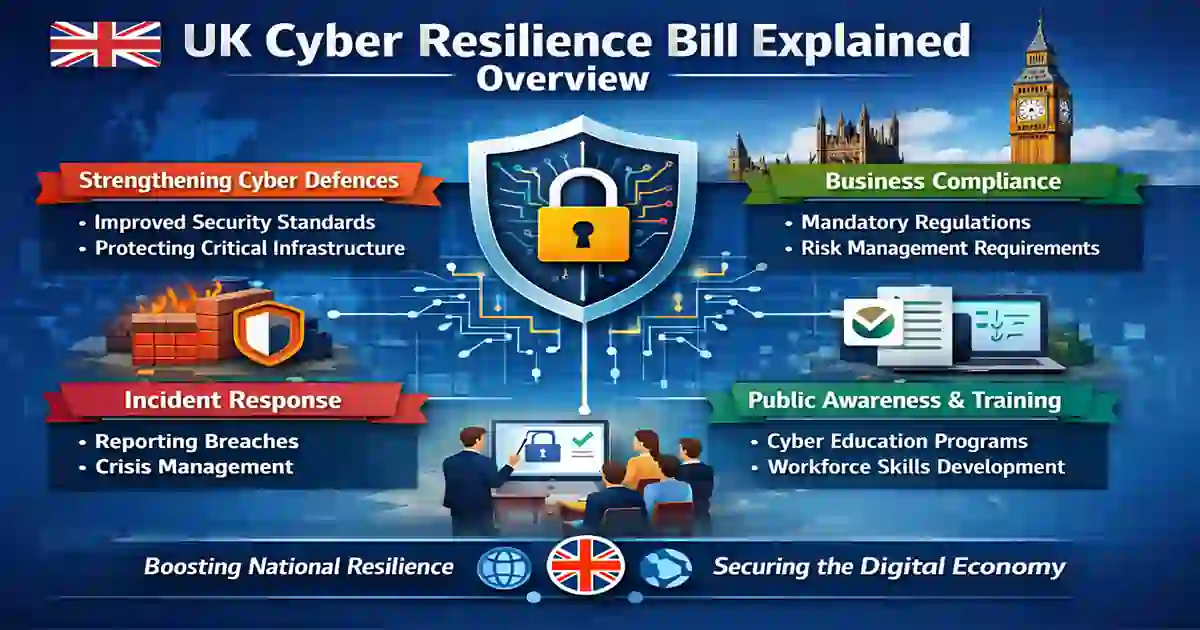
The bill is designed to update the UK’s current cyber resilience framework for essential services and related digital infrastructure.
According to the government’s bill summary, the proposal would widen parts of the current NIS regime, strengthen cyber security duties, improve incident reporting, and give regulators and government additional tools where resilience or national security issues arise. The official bill page also describes it as legislation about the security and resilience of network and information systems used or relied on in connection with essential activities.
In practical terms, this means the UK is pushing further beyond a narrow breach-notification mindset. The emphasis is moving toward service continuity, supplier dependencies, infrastructure resilience, and faster escalation when serious cyber incidents occur.
For broader reader context, you can add external dofollow links such as Cyber-security regulation on Wikipedia and Network and information systems on Wikipedia.
Why the UK is changing the rules
The government’s case is that the older framework no longer fully reflects the scale of current cyber threats or the UK’s dependence on connected services, digital infrastructure, and third-party providers. The policy material says the reforms are meant to improve UK cyber defences and better protect services the public relies on every day.
That makes sense in real operational terms. A serious cyber incident may begin at a managed service provider, a hosting environment, or a supplier before the main operator feels the full impact.
This is one reason the post works well with internal links like How to Reduce Cybersecurity Detection Time, Incident Response Deadlines US UK, and SOC Efficiency Metrics 2026. The site’s existing content already connects detection speed and response performance to regulatory pressure and executive risk.
Who could fall into scope
One of the most important parts of any UK Cyber Resilience Bill Explained article is scope.
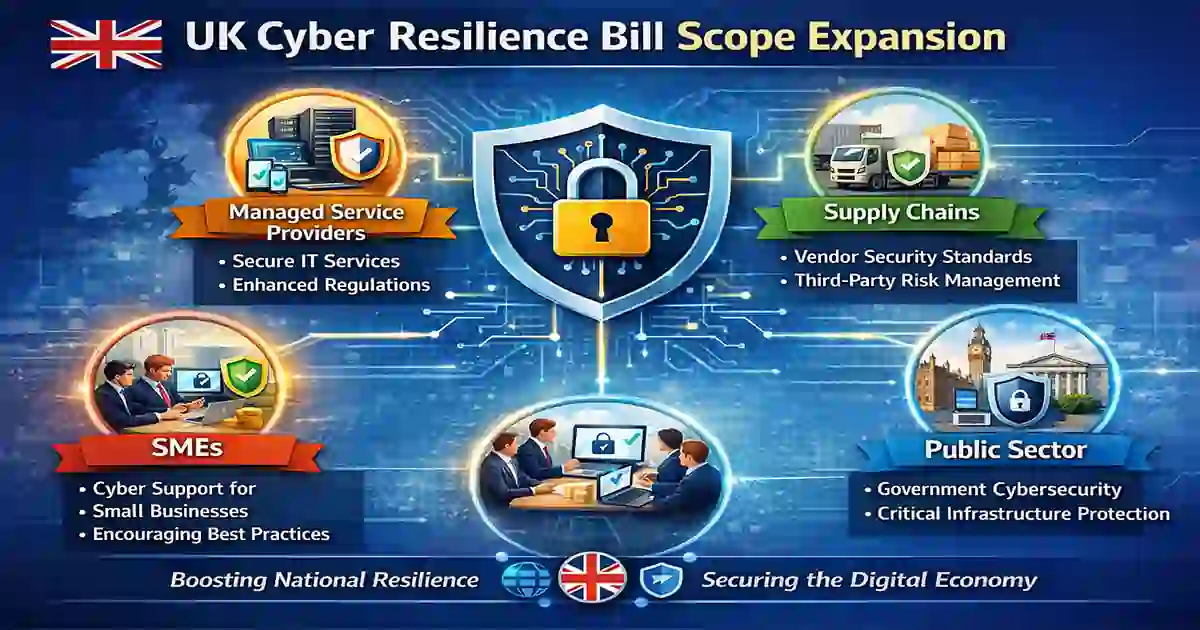
The bill is not meant to regulate every business in the UK. But the government’s summary says the reforms extend the regime to include managed service providers, data centres, large load controllers, and designated critical suppliers. The same summary says medium and large MSPs would be brought into scope, and qualifying data centres would be treated as essential services.
That means the bill matters not only to traditional essential-service operators, but also to organisations that support them through outsourced technology, infrastructure, and supply-chain relationships.
Helpful external links here include Managed services on Wikipedia and Data center on Wikipedia.
Helpful internal links here include Cybersecurity Metrics, Detection & Response Benchmarks, and Mean Time to Respond (MTTR). Those pages already exist on your site and support the resilience angle well.
Seven critical changes
1. Managed service providers are a major focus
One of the most important practical changes is the stronger attention given to MSPs.
The government says MSPs can have deep access to customer environments and may become high-impact attack paths, which is why medium and large providers are a major part of the proposed expansion.
2. Data centres are treated as resilience-critical infrastructure
The reforms also raise the profile of data centres.
Government material says data infrastructure will become part of the relevant NIS sector and qualifying data centres will be regulated as essential services. That is a strong signal that the UK now treats data infrastructure as a resilience issue, not just background technical support.
3. Critical suppliers may face more direct scrutiny
Another important change is the ability to designate especially important suppliers as critical suppliers.
That reflects the reality that cyber disruption often spreads through supplier relationships rather than only through the frontline operator. This is why internal resources like Third-Party Risk Assessment Checklist and Board-Level Cybersecurity Metrics Guide fit naturally in this section.
4. Incident reporting is likely to become faster and broader
A major part of the proposal is stronger incident reporting.
The government’s summary says the model would require an initial notification within 24 hours and a fuller report within 72 hours, with the NCSC informed at the same time. It also says the reporting duty would apply to a broader range of harmful incidents.
That is exactly why internal links to Mean Time to Respond and SOC Efficiency Metrics 2026 make sense here. Faster reporting depends on faster detection, triage, and escalation.
For broader reader context, you can also add Computer security incident management on Wikipedia.
5. National security powers are strengthened
The bill is not only a compliance update.
The parliamentary briefing says Part 4 of the bill creates directions for national security purposes, including powers to issue directions to regulated persons and to regulatory authorities.
6. Enforcement is expected to become stronger
The government says the reforms will simplify penalty structures and strengthen enforcement so regulators can respond more effectively to non-compliance. The official factsheets also cover monitoring, enforcement, and cost recovery as part of the wider package.
That does not mean every failure leads to immediate punishment, but it does point to a more active supervisory environment.
7. Governance and oversight become more important
A final theme is leadership accountability.
This proposal supports a world where cyber resilience is treated as a board and executive issue, not only a technical issue. That is why Board-Level Cybersecurity Metrics Guide and Cybersecurity Metrics are useful internal follow-ons for readers who want to connect compliance pressure with oversight and reporting.
What the bill does not mean
A balanced explainer should also make clear what these reforms do not mean.
They do not mean every UK business suddenly falls under the same duties. The regime remains targeted, even though it expands.
They do not replace all other cyber or privacy obligations. The bill amends the NIS framework, while other legal duties continue separately.
And they do not mean the final implementation picture is settled today. The Parliament stages page still shows report stage: date to be announced.
For a broader concept link, you can add Resilience on Wikipedia.
What organisations should do now
Even before final implementation details are settled, there are practical steps organisations can take now.
Review whether you are likely to be affected
If you run essential services, operate a medium or large MSP, manage a qualifying data centre, or support critical services through outsourced operations, you should monitor the bill closely.
Tighten incident escalation and reporting workflows
If the 24-hour and 72-hour structure remains, organisations will need tighter coordination between security, legal, operations, and communications.
Reassess supplier dependencies
Supplier governance becomes more important when critical suppliers may face direct regulatory attention.
Bring leadership into the discussion
Cyber resilience is clearly a governance topic. That makes these internal links especially relevant:
- Board-Level Cybersecurity Metrics Guide
- Incident Response Deadlines US UK
- Third-Party Risk Assessment Checklist
Final thoughts
A clear UK Cyber Resilience Bill Explained article helps readers understand the broader shift underway in the UK. The direction is clear: stronger resilience expectations, broader scope, faster reporting, and closer scrutiny of supplier exposure and governance.
For some organisations, that will mean direct legal obligations. For others, it will mean tighter customer expectations, more supplier oversight, and greater board attention. Either way, this is a development worth watching closely.