
Average Ransomware Containment Time 2026: 7 Shocking Trends
The Average Ransomware Containment Time 2026 has become one of the most important cybersecurity performance metrics for organizations across the United States and United Kingdom.
While detection time often receives the spotlight, containment time determines how quickly an organization stops ransomware from spreading across its environment. In modern attacks, threat actors escalate privileges, move laterally, disable backups, and exfiltrate sensitive data before encryption completes.
The longer containment takes, the greater the operational damage and regulatory exposure.
Understanding the Average Ransomware Containment Time 2026 helps security leaders measure resilience and improve incident response effectiveness.
Table of Contents
📌 What is Ransomware Containment Time?
Ransomware containment time refers to the duration between confirmed malicious activity and full isolation of affected systems to prevent further spread.
Containment typically includes:
- Isolating infected endpoints
- Blocking command-and-control traffic
- Disabling compromised credentials
- Stopping lateral movement
- Securing backup infrastructure
Containment is not the same as recovery.
Recovery may take days or weeks.
Containment focuses on stopping the attack quickly.
This metric differs from:
- Mean Time to Detect (MTTD) – how long it takes to identify the attack
- Dwell Time – how long attackers remain undetected
- Mean Time to Respond (MTTR) – overall response lifecycle
👉 Related internal resources:
👉 Mean Time to Detect (MTTD)
👉 Dwell Time
The Average Ransomware Containment Time 2026 measures how quickly organizations limit damage once ransomware activity is confirmed.
📊 Average Ransomware Containment Time 2026 Benchmarks
Based on industry case studies, SOC reporting data, and incident response analyses, estimated benchmarks show:
- 6–12 hours in highly mature enterprise environments
- 12–36 hours in mid-sized organizations
- 48–96+ hours in under-resourced environments
Organizations with automated isolation tools consistently outperform those relying on manual containment procedures.
The Average Ransomware Containment Time 2026 is heavily influenced by detection maturity. Faster detection naturally reduces containment delays.
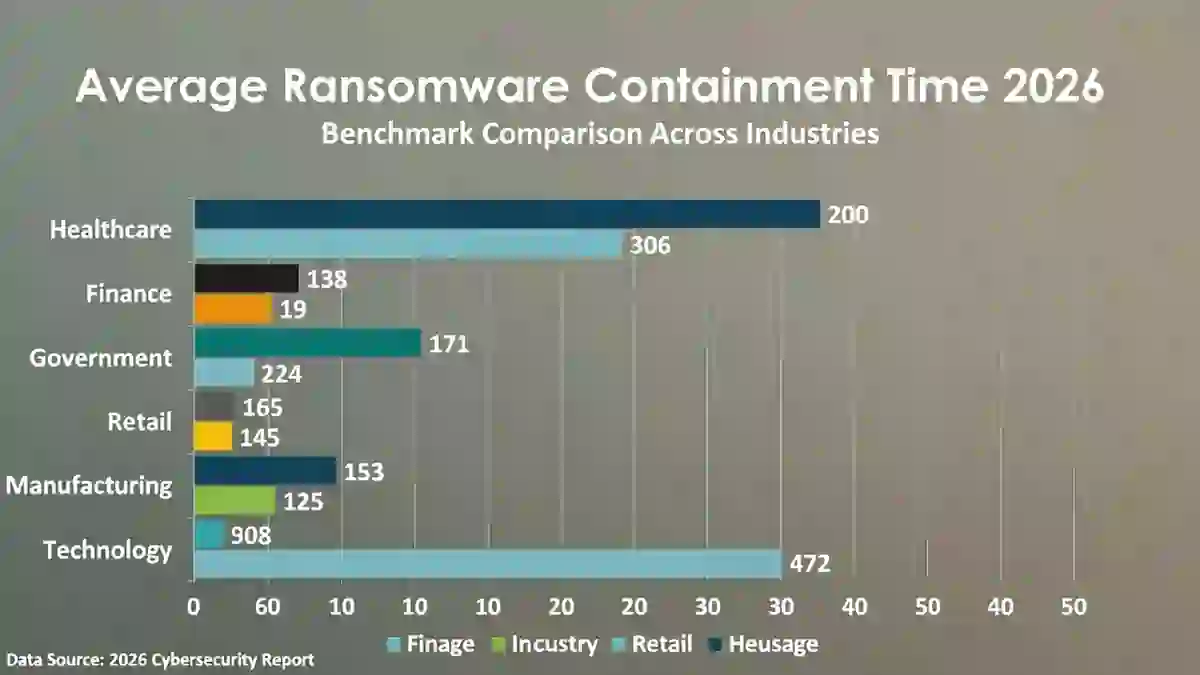
🏥 Industry Differences in 2026
Containment time varies significantly by sector.
Healthcare
- Often 24–72 hours
- Complex networks and legacy systems delay isolation
- Patient safety considerations slow aggressive shutdown
Financial Services
- 6–18 hours
- Advanced monitoring tools and segmentation
- Strong regulatory pressure drives rapid action
Government
- 24–72 hours
- Cross-department coordination challenges
- Approval processes slow containment decisions
Energy & Critical Infrastructure
- 12–48 hours
- Operational technology networks complicate isolation
Industries with zero trust architecture and strong segmentation report shorter containment durations.
🚨 Why Containment Speed Matters More in 2026
The financial impact of ransomware increases exponentially over time.
Longer containment windows result in:
- Higher operational downtime
- Greater data exfiltration risk
- Larger ransom negotiation leverage
- Increased regulatory reporting complexity
Under frameworks like:
- CIRCIA (72-hour reporting rule)
- SEC cybersecurity disclosure requirements
- UK 72-hour GDPR reporting obligations
containment speed affects compliance readiness.
The Average Ransomware Containment Time 2026 now influences both financial and regulatory outcomes.
⚠ Factors That Delay Containment
Several operational weaknesses increase containment time:
- Lack of endpoint visibility
- Poor network segmentation
- Manual incident response processes
- Incomplete playbooks
- Delayed executive authorization
Hybrid cloud environments also introduce complexity. Attackers often exploit misconfigurations across on-prem and cloud systems.
Without automated response orchestration, isolation decisions take longer.
🔧 How to Reduce Average Ransomware Containment Time 2026
Organizations can significantly reduce containment time by implementing:
1️⃣ Automated Endpoint Isolation
Modern EDR and XDR platforms allow instant quarantine of infected systems.
2️⃣ Strong Network Segmentation
Limiting lateral movement reduces spread radius.
3️⃣ Incident Response Playbooks
Pre-approved actions eliminate decision bottlenecks.
4️⃣ 24/7 SOC Monitoring
Continuous visibility reduces detection-to-containment delay.
5️⃣ Regular Tabletop Exercises
Simulation improves coordination speed during real incidents.
Organizations that track containment time as a key performance indicator consistently improve resilience year over year.
📈 Future Outlook
Ransomware operators are automating attack phases.
Some modern ransomware campaigns can encrypt environments in under four hours.
As attacker speed increases, organizations must reduce the Average Ransomware Containment Time 2026 to single-digit hours.
Artificial intelligence-driven detection and automated containment orchestration will define next-generation resilience.
Containment time is no longer just a technical metric.
It is a board-level resilience indicator.
Final Thoughts
The Average Ransomware Containment Time 2026 reflects how prepared an organization truly is against modern cyber threats.
Detection matters.
But containment determines impact.
Organizations that reduce containment time below 12 hours significantly limit:
- Financial loss
- Operational disruption
- Regulatory exposure
- Reputational damage
In 2026, cybersecurity timing defines business survival.