SPRS Affirmation Guide for CMMC and NIST SP 800-171 Contractors
If you need an SPRS Affirmation Guide, start with the basic distinction: SPRS is the Department of Defense system used to store supplier cyber assessment data, including NIST SP 800-171 assessment results and CMMC assessment and affirmation records. DISA describes SPRS as the DoD’s authorized supplier performance application, and the current CMMC rule says required affirmations are entered electronically in SPRS. For internal context, this topic fits naturally with CMMC 2.0 Phase 1 Checklist: 12 Essential Steps to Avoid Costly Delays in 2026, CMMC Level 1 vs Level 2 Self-Assessment: Avoid Mistakes, and your broader compliance coverage on Cybersecurity Time.
A practical SPRS Affirmation Guide should explain two related workflows that contractors often confuse. First, contractors submit NIST SP 800-171 assessment results into SPRS. Second, CMMC requires an Affirming Official to submit affirmations tied to assessment completion and continuing compliance. The DoD’s CMMC resources page reminds contractors to submit affirmations with CMMC assessments in SPRS, and 32 CFR 170.22 lays out the timing rules. For related internal reading, this also pairs well with Vendor Security Questionnaire Template: 7 Key Questions and Board-Level Cybersecurity Metrics Guide: 7 Critical Risks.
This SPRS Affirmation Guide is written for U.S. defense contractors that need to understand who affirms, when affirmations are required, what information should be ready before logging in, and how to avoid common role and timing mistakes. The official SPRS quick-entry guides and Affirming Official training materials make the workflow much clearer than general summaries alone.
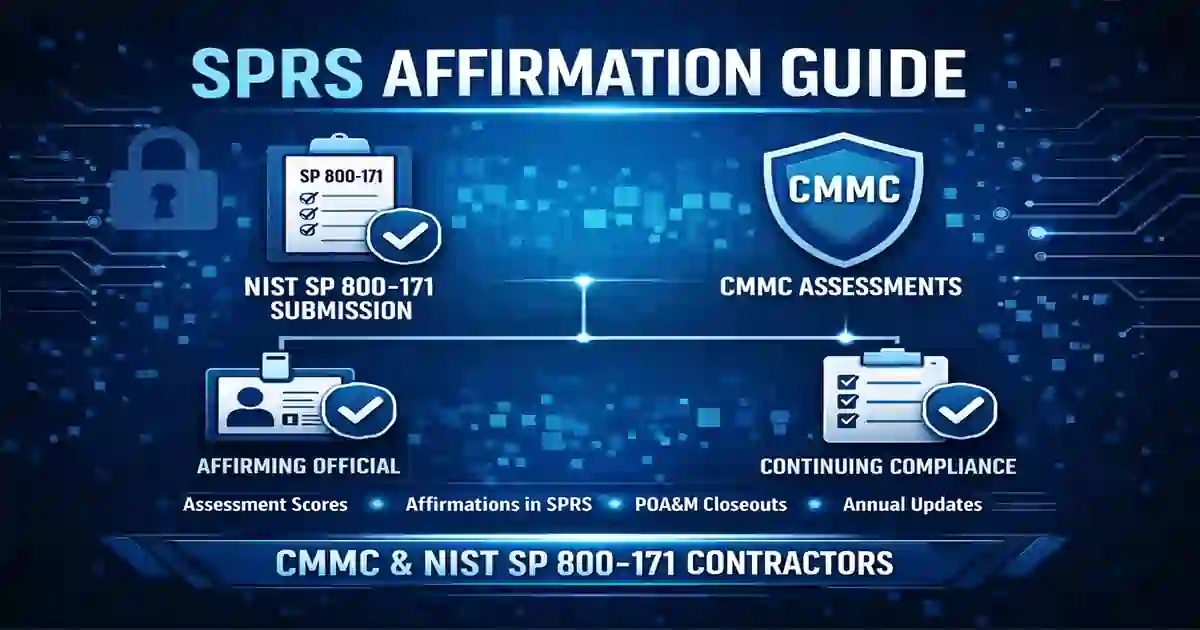
Table of Contents
What is SPRS?
https://cybersecuritytime.com/kev-vs-cvss-patch-priority/SPRS, short for the Supplier Performance Risk System, is the DoD platform that stores supplier-related performance data and cyber assessment information. The official SPRS NIST page says it stores NIST SP 800-171 assessment scoring details such as assessment date, score, scope, CAGE codes, SSP name, SSP version, SSP date, and confidence level. For internal support, this also aligns with KEV vs CVSS Patch Priority: 7 Critical Facts and Board-Level Cybersecurity Metrics Guide: 7 Critical Risks because both focus on turning security work into formal decision data.
A good SPRS Affirmation Guide should also make clear what SPRS does not do. SPRS stores the assessment results, but the underlying NIST SP 800-171 Basic Assessment is completed outside the system. That distinction matters because some contractors still assume SPRS is where the self-assessment itself is conducted. For readers who want plain-language background on federal contractor identifiers, a general reference like Wikipedia’s CAGE code article can also help explain related terminology.
What is an SPRS Affirmation?
In the CMMC context, an affirmation is the attestation by an authorized senior official that the organization continues to comply with the applicable CMMC security requirements. The current rule says an Affirming Official from each organization seeking assessment must affirm continuing compliance after every assessment, including POA&M closeout when applicable, and annually thereafter, and these affirmations are entered electronically in SPRS. For internal continuity, this section also fits with CMMC 2.0 Phase 1 Checklist: 12 Essential Steps to Avoid Costly Delays in 2026.
That means an SPRS Affirmation Guide is mainly about the CMMC affirmation workflow, not a separate universal annual affirmation rule for every plain NIST SP 800-171 score entry. NIST SP 800-171 results still go into SPRS, but the specific annual continuing-compliance rule in the current CMMC framework is tied to CMMC assessment status. The DoD CMMC resource page reinforces that by explicitly reminding contractors to submit affirmations with CMMC assessments in SPRS.
Who Can Submit an Affirmation?
The key person in any SPRS Affirmation Guide is the Affirming Official, often shortened to AO in official SPRS materials. The AO is the senior-level representative within the organization seeking assessment who is responsible for ensuring compliance with CMMC program requirements and has authority to affirm continuing compliance. For internal context, that accountability model also pairs well with Board-Level Cybersecurity Metrics Guide: 7 Critical Risks.
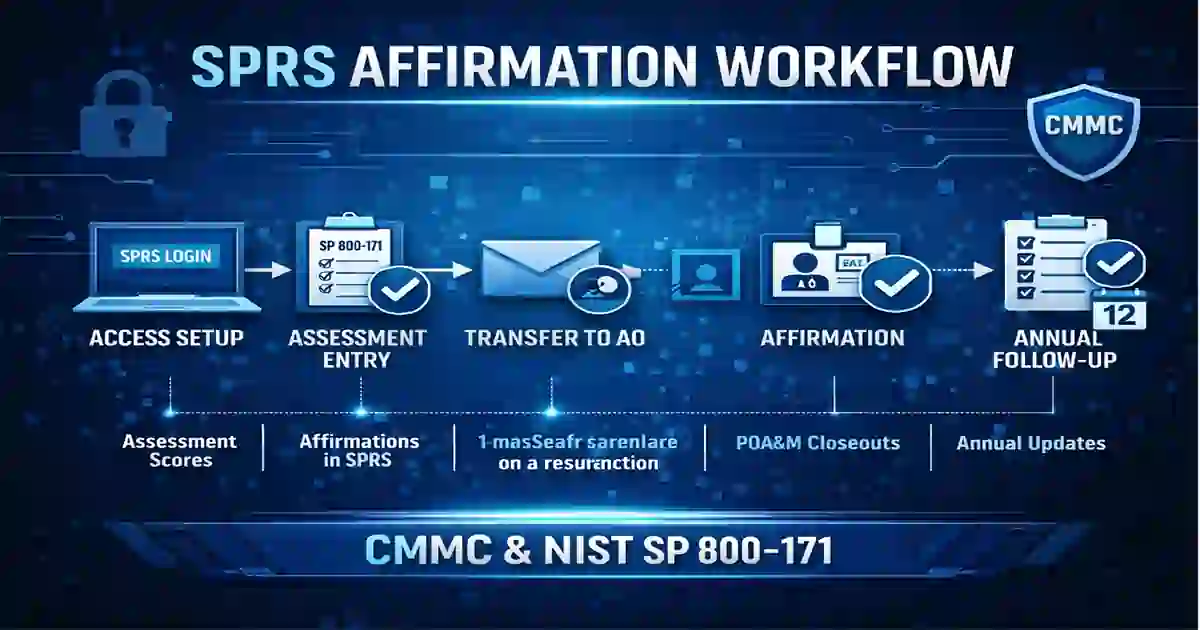
A practical SPRS Affirmation Guide should also explain that the person entering the assessment record is not always the same person who affirms it. Official SPRS quick-entry materials show that if the entry user is not the AO, the assessment can be routed using Transfer to AO, after which the AO reviews the information and selects Affirm. For internal support, this also pairs well with Vendor Security Questionnaire Template: 7 Key Questions.
When is SPRS Affirmation Required?
Under the current CMMC rule, the timing depends on the assessment path. For Level 1 self-assessments, the Affirming Official submits an affirmation at the completion of the self-assessment and annually thereafter. For Level 2 self-assessments, the AO affirms at completion, annually following a Final CMMC Status Date, and at completion of a POA&M closeout self-assessment when applicable. Similar timing logic applies to Level 2 certification and Level 3 certification pathways. For internal context, this also fits your article CMMC Level 1 vs Level 2 Self-Assessment: Avoid Mistakes.
The timing is operationally important now, not just theoretically important later. The DoD’s current rollout places Phase 1 from November 10, 2025 through November 9, 2026, and that phase focuses primarily on Level 1 and Level 2 self-assessments. Contractors in that phase should not treat affirmation as an optional administrative follow-up. They should treat it as part of the compliance workflow itself.
What You Need Before You Log In
Before starting the workflow, a useful SPRS Affirmation Guide should tell you to confirm access, CAGE code coverage, assessment details, and AO readiness. Contractors need the correct SPRS access through PIEE and should know which CAGE code or codes are tied to the applicable system security plan. For internal related reading, this also connects with Third-Party Risk Assessment Checklist 2026: 12 Proven Steps and your broader content on Cybersecurity Time.
The same official guidance indicates that SPRS stores common submission details such as assessment date, score, scope, SSP name, SSP version, SSP date, included CAGE codes, and confidence level. For CMMC affirmation, the AO should also be ready to review the record details carefully and verify the affirmation before submission.
7 Critical SPRS Affirmation Steps
1. Confirm the correct compliance path
Start by confirming whether you are handling a NIST SP 800-171 assessment result submission, a CMMC Level 1 self-assessment, a CMMC Level 2 self-assessment, or another CMMC assessment record. A proper SPRS Affirmation Guide should begin here because the affirmation requirement in the current rule is tied to the CMMC workflow, while NIST result storage follows its own SPRS process. For internal context, this also supports CMMC 2.0 Phase 1 Checklist: 12 Essential Steps to Avoid Costly Delays in 2026.
2. Make sure the right SPRS role is in place
Contractors need the correct SPRS access through PIEE, and the record must align with the correct CAGE code context. A good SPRS Affirmation Guide should treat role setup as an early task rather than a last-minute hurdle, because access problems are one of the easiest ways to delay submissions.
3. Gather the assessment details before entry
Before entering anything, collect the assessment date, score, scope, applicable CAGE codes, SSP name, SSP version, SSP date, and supporting details. The official SPRS material shows these are standard data fields for NIST SP 800-171 submissions. For internal continuity, this also pairs with Board-Level Cybersecurity Metrics Guide: 7 Critical Risks, because both topics emphasize reliable evidence and formalized reporting.
4. Enter the assessment in the correct SPRS cyber module
The SPRS NIST submission area covers NIST SP 800-171 assessment result storage, while the CMMC area covers assessment and affirmation workflows. A strong SPRS Affirmation Guide should explain that not every cyber workflow in SPRS follows the exact same path. That distinction reduces unnecessary confusion during first-time submissions. For internal support, this also fits with the compliance-focused articles already published on Cybersecurity Time.
5. Transfer to the Affirming Official if needed
If the person entering the record is not the AO, the record should be sent using Transfer to AO by entering the AO’s email address. This is one of the most important steps in any SPRS Affirmation Guide because many incomplete workflows happen when contractors enter the record but never route it for final affirmation.
6. Have the AO review and affirm carefully
The AO should review the information, verify the relevant details, certify review of the affirmation statement, and then select Affirm. This review-and-affirm step is central to the workflow and should not be treated as a routine click-through. For internal context, this also pairs with Vendor Security Questionnaire Template: 7 Key Questions, since both processes depend on evidence-backed signoff rather than assumptions.
7. Track annual and follow-up affirmation obligations
Use this SPRS Affirmation Guide as a repeatable reference, not a one-time checklist. The rule says affirmations continue annually following the applicable CMMC status date and also occur after POA&M closeout when applicable. Contractors should calendar those obligations rather than assuming the workflow ends after the first entry. For internal support, this also aligns with CMMC Level 1 vs Level 2 Self-Assessment: Avoid Mistakes and CMMC 2.0 Phase 1 Checklist: 12 Essential Steps to Avoid Costly Delays in 2026.
Common Contractor Mistakes
One common mistake is assuming that SPRS itself performs the NIST SP 800-171 Basic Assessment. It does not. SPRS stores the results after the contractor completes the underlying assessment work. Another common mistake is assuming the same user who enters the record can always complete the affirmation even when that person is not the designated AO. A clear SPRS Affirmation Guide should correct both assumptions early. For internal context, this also supports CMMC Level 1 vs Level 2 Self-Assessment: Avoid Mistakes.
Another mistake is forgetting that affirmation is ongoing under the CMMC rule. Contractors may complete the first assessment and then overlook the annual continuing-compliance affirmation requirement tied to status timing. That can create avoidable compliance gaps even when the original assessment was submitted correctly.
Final Checklist
Before considering your work complete, make sure you can answer yes to these questions:
- Did we complete the underlying assessment outside SPRS where required?
- Do we have the right SPRS role and CAGE code coverage?
- Did we enter the assessment in the correct module?
- If the entry user is not the AO, did we transfer the record correctly?
- Did the AO actually review and affirm it?
- For CMMC, did we calendar the next required affirmation date?
A strong SPRS Affirmation Guide is most useful when treated as a repeatable process reference, not a one-time summary. For internal follow-on reading, the most relevant pages on your site are CMMC 2.0 Phase 1 Checklist: 12 Essential Steps to Avoid Costly Delays in 2026, CMMC Level 1 vs Level 2 Self-Assessment: Avoid Mistakes, and Vendor Security Questionnaire Template: 7 Key Questions.
FAQ
Is SPRS the place where I do the NIST SP 800-171 Basic Assessment?
No. SPRS stores the assessment results, but the underlying NIST SP 800-171 Basic Assessment is completed outside the platform. This is one of the first points any SPRS Affirmation Guide should clarify. For internal context, this also pairs with your homepage at Cybersecurity Time.
Is affirmation required only once?
No for CMMC. The rule requires affirmations after the assessment, annually thereafter based on the applicable pathway, and after POA&M closeout when applicable. That is why a repeatable SPRS Affirmation Guide matters. For internal support, this also aligns with CMMC 2.0 Phase 1 Checklist: 12 Essential Steps to Avoid Costly Delays in 2026.
Who is the Affirming Official?
The Affirming Official is the senior-level representative from the organization seeking assessment who is responsible for ensuring compliance with CMMC program requirements and has authority to affirm continuing compliance. A practical SPRS Affirmation Guide should make this role distinction explicit. For internal continuity, this also connects with Board-Level Cybersecurity Metrics Guide: 7 Critical Risks.
Can a different user enter the assessment and then send it to the AO?
Yes. The official SPRS workflow allows the record to be transferred to the AO using Transfer to AO, after which the AO reviews and affirms it. That is one of the most practical details in any SPRS Affirmation Guide. For internal support, this also pairs with Vendor Security Questionnaire Template: 7 Key Questions.
Why is an SPRS Affirmation Guide important?
An SPRS Affirmation Guide helps contractors avoid role confusion, missed affirmations, incomplete entries, and timing errors in the SPRS workflow. It is especially useful for first-time submissions, annual affirmations, and POA&M closeout steps. For internal context, this also fits naturally with the compliance-focused guidance already published on Cybersecurity Time