Post-Quantum Migration Roadmap: 7 Best Steps
A Post-Quantum Migration Roadmap is a structured plan that helps security teams prepare for the move from current public-key cryptography to quantum-resistant alternatives. As quantum computing research advances, organizations are being pushed to understand where cryptography is used, which systems are most exposed, and how migration can be managed over time. Guidance from NIST and the UK NCSC shows that this transition will take years, not weeks.
For security leaders, this is more than a future research topic. It affects encryption, certificates, authentication, software supply chains, vendor contracts, and long-term data confidentiality. That is why this topic fits naturally with Cybersecurity Time content such as Vendor Security Questionnaire Template, Third-Party Risk Assessment Checklist, and Cybersecurity Best Practices, all of which focus on structured security planning.

Table of Contents
What is a Post-Quantum Migration Roadmap?
A Post-Quantum Migration Roadmap is a phased approach for identifying cryptographic dependencies, prioritizing business risk, testing quantum-safe replacements, and rolling out changes gradually. In broader reference terms, this falls under post-quantum cryptography, which focuses on cryptographic systems intended to resist attacks from future quantum computers.
The main reason to plan early is that organizations often do not know exactly where cryptography is embedded. Certificates, VPNs, APIs, code-signing systems, identity platforms, archived data, and vendor products may all rely on algorithms that eventually need review. A roadmap gives security teams a way to organize that work before the pressure becomes urgent.
Why security teams need one
Security teams need a roadmap because cryptographic migration is complex and cross-functional. It touches architecture, procurement, vendor management, compliance, and executive reporting, not just technical controls. A practical plan helps answer key questions: Where is cryptography used today? Which systems protect long-life sensitive data? Which suppliers may slow migration? Which environments are flexible enough to support change?
This governance angle aligns well with Cybersecurity Time pages such as Information Security Guide and Incident Response Deadlines US UK, because readiness is often about visibility and planning as much as technical execution.
7 best steps in a Post-Quantum Migration Roadmap
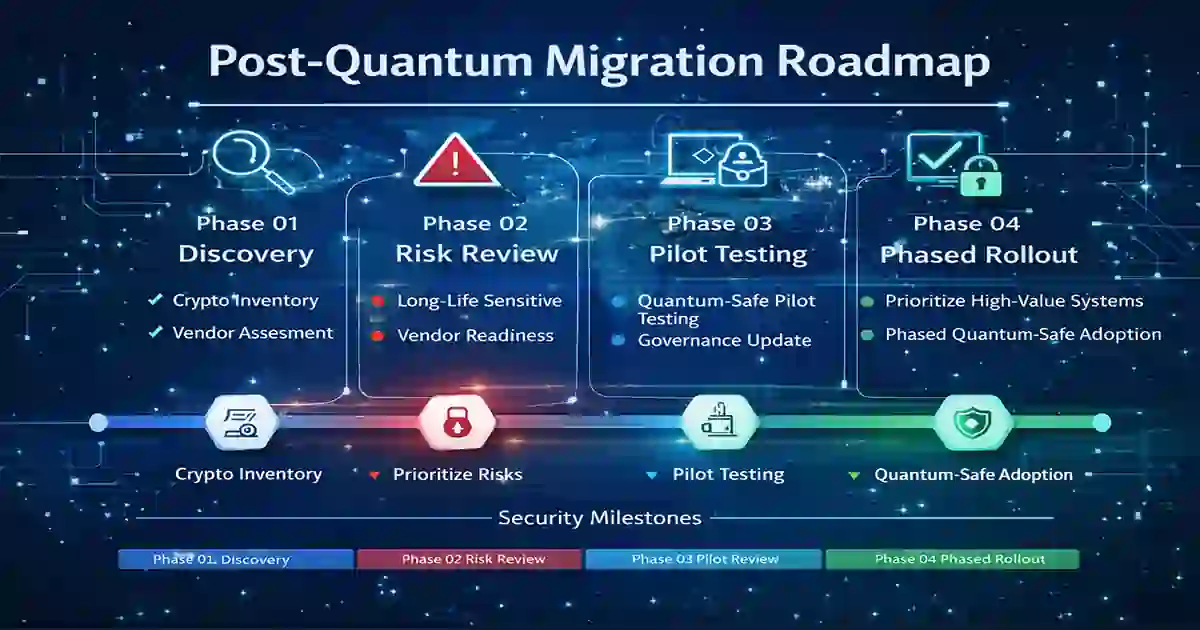
1. Build a cryptographic inventory
The first step is to find where cryptography is used across applications, certificates, key stores, APIs, cloud services, and devices. Without inventory, migration decisions will be incomplete from the start. This is similar to the structured discovery approach used in Vendor Security Questionnaire Template.
2. Prioritize long-life sensitive data
Some information needs confidentiality for many years. Intellectual property, legal records, strategic plans, and regulated data deserve early attention because they may be exposed to “harvest now, decrypt later” risks. This concept is often discussed in post-quantum planning because data stolen today could become readable in the future.
3. Assess cryptographic agility
Organizations should determine whether systems can change algorithms, certificates, or cryptographic libraries without major redesign. Flexible systems are easier to update, while rigid environments may require expensive remediation. This type of prioritization is also consistent with Third-Party Risk Assessment Checklist, where hidden dependency matters as much as direct exposure.
4. Review vendor readiness
A strong roadmap should include supplier and vendor review. Cloud providers, certificate services, software vendors, and managed security partners all influence migration timelines. That makes this topic a natural fit for Cybersecurity Time’s vendor-risk coverage, especially Vendor Security Questionnaire Template and Third-Party Risk Assessment Checklist.
5. Start pilot testing
Pilot projects allow teams to test compatibility, performance, certificate handling, and operational overhead before full rollout. This matters because post-quantum cryptographic approaches may affect key sizes, signatures, and system behavior differently than older methods.
6. Update governance and policy
Post-quantum planning should appear in architecture review, procurement language, security standards, and executive reporting. It should not be treated as a side project. This broader governance view matches the tone of Compliance & Reporting content on your site.
7. Roll out in phases
Migration should happen in stages. High-value systems, exposed services, long-life data, and hard-to-upgrade platforms should be prioritized first. Both NIST and the NCSC emphasize transition planning rather than rushed replacement.
Common migration challenges
The biggest challenge is incomplete visibility. Many organizations do not know where cryptography is deeply embedded in applications, hardware, vendor tools, or legacy integrations. Another challenge is architectural rigidity, since older systems may not support cryptographic agility. Vendor dependency is also a major issue, because even prepared organizations can be slowed by third parties that are less ready.
Testing can also create delays. Performance, interoperability, and certificate changes all need to be evaluated carefully before broader rollout. That is why this roadmap fits naturally with Cybersecurity Time content like Cybersecurity Incident Response Timeline and Reduce Detection Time Regulatory Deadlines Risk: in both cases, preparation matters more when it starts before pressure peaks.
Final thoughts
A Post-Quantum Migration Roadmap gives security teams a practical way to move from awareness to action. It starts with discovery, prioritizes sensitive assets, includes vendor review, and uses phased rollout to reduce disruption. For CybersecurityTime.com, this works well as roadmap-style content because it connects strategy, vendor risk, governance, and long-term resilience in one topic.