Cyber Essentials for UK Government Contracts: 7 Smart Rules
Cyber Essentials for UK Government Contracts matters to suppliers that want to bid for public sector work without avoidable compliance delays. The key point is straightforward: Cyber Essentials is important in UK procurement, but it is not required for every government contract. The current Cabinet Office policy says buyers must not take a blanket approach and should only require Cyber Essentials or Cyber Essentials Plus where the contract risk makes that proportionate.
If you want related internal reading on Cybersecurity Time, this topic fits naturally with Cyber Essentials vs Cyber Essentials Plus: 7 Critical Facts, Cyber Essentials 2026 Changes Explained: Avoid 7 UK Failures, Vendor Security Questionnaire Template: 7 Key Questions, and Cybersecurity Best Practices.

Table of Contents
What Cyber Essentials for UK Government Contracts Means
Cyber Essentials for UK Government Contracts refers to the use of the UK government-backed Cyber Essentials scheme as a supplier assurance requirement in relevant procurements. The National Cyber Security Centre describes Cyber Essentials as the minimum cyber security standard recommended by the UK Government and says it is built around five technical controls that help defend against common internet-based attacks.
Those five areas are boundary firewalls and internet gateways, secure configuration, access control, malware protection, and security update management. The NCSC’s technical requirements also stress that organisations need to define scope properly before assessment. For background reading, you can link to the official NCSC Cyber Essentials overview and the government’s Cyber Essentials scheme overview.
That is why Cyber Essentials for UK Government Contracts is not just a certification topic. It is also a procurement readiness topic. Public buyers may use it to confirm that a supplier has addressed common baseline cyber risks before handling sensitive data or supporting important services.
Do All Suppliers Need Cyber Essentials for UK Government Contracts?
No. This is the first point suppliers should understand.
The current Procurement Policy Note says Cyber Essentials for UK Government Contracts must not be imposed on all contracts as a blanket rule. In-scope organisations are told to apply cyber requirements in a proportionate way and only where the characteristics of the contract justify them.
That means suppliers do not automatically need Cyber Essentials for UK Government Contracts just because they want to sell to government. The real question is whether the contract involves the kinds of systems, services, or information that create higher cyber risk.
When Suppliers Need Cyber Essentials for UK Government Contracts
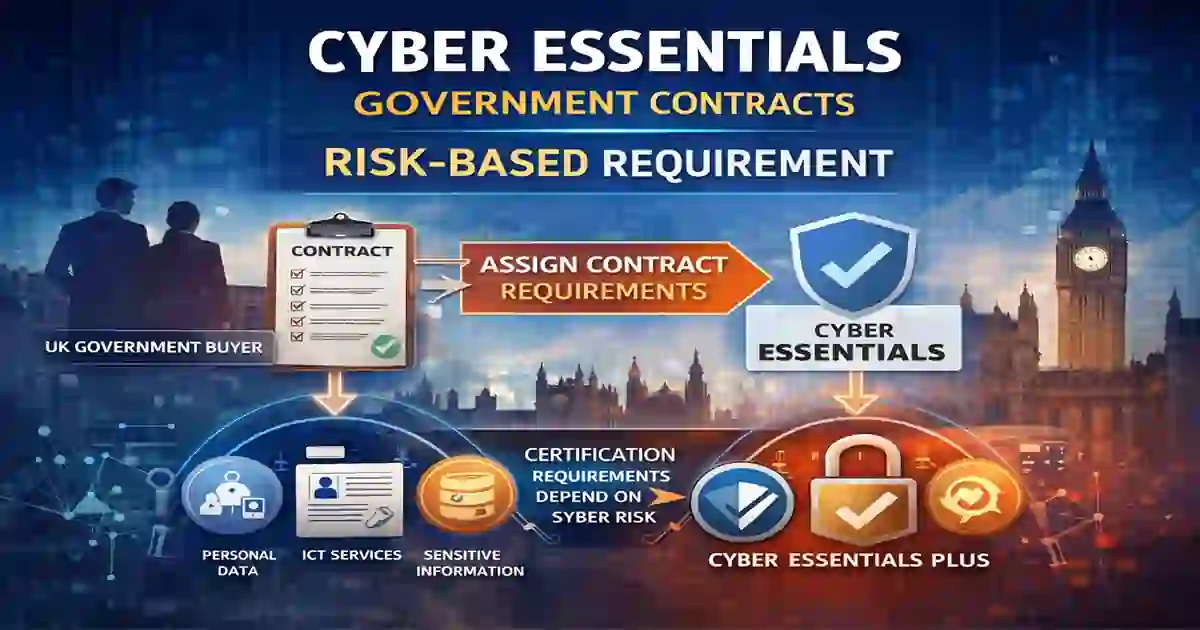
In practice, suppliers usually need Cyber Essentials for UK Government Contracts when the contract includes one or more higher-risk characteristics identified in the current government policy.
The Cabinet Office guidance highlights contracts where the supplier will handle citizens’ personal information such as home addresses, bank details, or payment information. It also highlights contracts involving personal information about government employees, ministers, or special advisers, including payroll, expenses, or travel-related information.
Suppliers may also need Cyber Essentials for UK Government Contracts where they provide ICT systems or services designed to store or process information at the OFFICIAL level, or where the contract supports day-to-day government business, service delivery, public finances, criminal justice, resilience, defence, or commercially sensitive information provided in confidence.
So the practical test is not simply whether the customer is public sector. The practical test is whether the contract exposes systems, data, or operations to cyber risk that the buyer wants controlled through baseline certification or clearly equivalent controls. That is why this topic also links well to your internal article Vendor Security Questionnaire Template: 7 Key Questions.
When Cyber Essentials Plus Is Better for UK Government Contracts
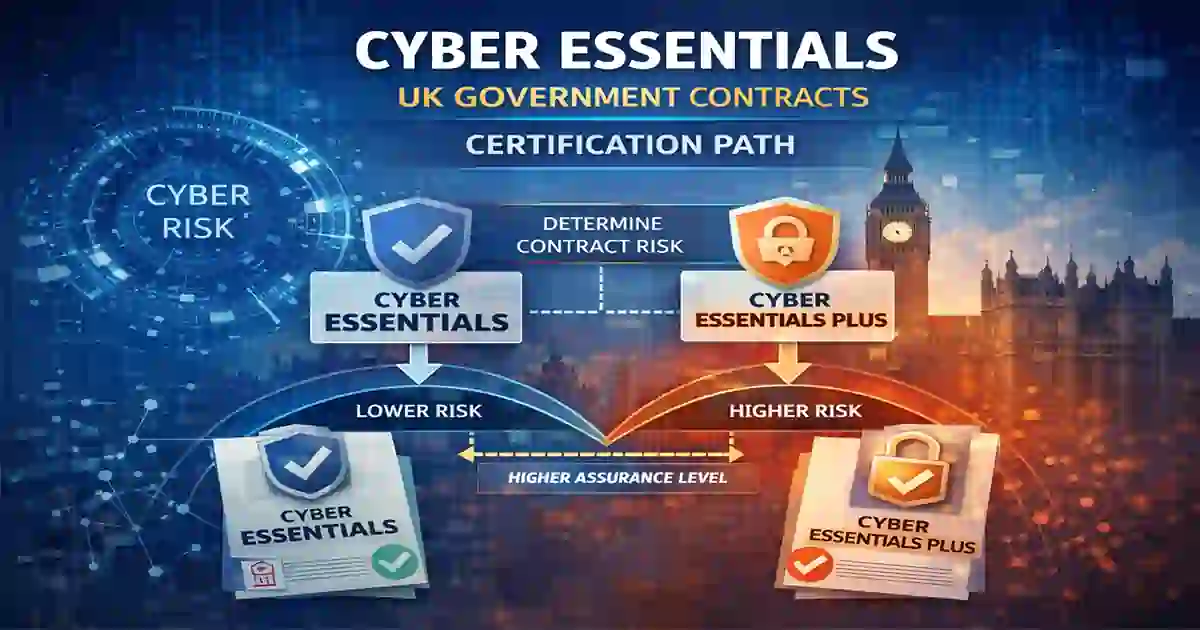
Cyber Essentials for UK Government Contracts does not always mean the basic Cyber Essentials certificate is enough. The same policy note says Cyber Essentials Plus provides a higher level of assurance and should be used where there is a higher risk of cyber security threats.
In practical terms, Cyber Essentials may fit lower-risk but still relevant contracts, while Cyber Essentials Plus is more suitable where the systems, data, or exposure create a stronger need for independent validation. That reading follows directly from the policy’s risk-based approach and the NCSC’s scheme overview.
For internal context, this is a natural place to link to Cyber Essentials vs Cyber Essentials Plus: 7 Critical Facts. For external context, a plain-language explainer like Wikipedia’s Cyber Essentials page can help general readers understand the scheme at a high level, although the official NCSC and GOV.UK sources should remain the main authority.
When Suppliers Must Show Certification
Timing matters because Cyber Essentials for UK Government Contracts is usually checked before contract award, not after.
The current policy says suppliers bidding for in-scope contracts must normally demonstrate before award that they hold Cyber Essentials, Cyber Essentials Plus, or equivalent controls. It also says buyers should flag that requirement as early as possible in the procurement process, including in the tender notice for competitive procedures.
There is a narrow exception where an organisation may make a risk-based decision to let a contract begin while a supplier renews an expired certificate. Even in that case, the supplier must still demonstrate the required certification or equivalent controls before any data is passed to the supplier.
This means suppliers should treat Cyber Essentials for UK Government Contracts as bid infrastructure, not as post-award administration. The Crown Commercial Service has also published supplier-focused guidance on Cyber Essentials certification for SMEs, which can be a useful supporting reference.
Equivalent Controls and ISO 27001 Confusion
One of the biggest misunderstandings around Cyber Essentials for UK Government Contracts is the idea of equivalent controls. The policy does allow suppliers to demonstrate equivalent controls instead of holding a Cyber Essentials certificate, but it does not allow vague claims of good security in place of actual evidence. Buyers still need confidence that the controls match the contract risk.
The same policy is also clear that ISO 27001 does not automatically prove conformity with Cyber Essentials, because the five Cyber Essentials controls may not all be in scope or tested under ISO 27001 in the way the procurement expects.
This is why suppliers should not assume a respected certification automatically solves a Cyber Essentials requirement. For internal follow-up, this section pairs well with Cyber Essentials 2026 Changes Explained: Avoid 7 UK Failures.
7 Supplier Mistakes to Avoid
1. Assuming every public contract requires Cyber Essentials
The current government policy explicitly rejects a blanket approach.
2. Waiting too late to prepare
Because evidence is usually needed before award, late certification can weaken or delay a bid.
3. Confusing Cyber Essentials with Cyber Essentials Plus
Cyber Essentials Plus provides a higher level of assurance and may be more suitable for higher-risk contracts.
4. Assuming ISO 27001 automatically replaces Cyber Essentials
The policy says it does not automatically do so.
5. Ignoring scope
The NCSC technical requirements stress the need for correct scope definition.
6. Forgetting annual renewal
Where certification is required for the contract, suppliers must renew it every 12 months.
7. Overlooking third-party and cloud dependencies
The policy tells buyers to examine certificate scope carefully, especially where third parties are involved.
Final Checklist
Before bidding, suppliers should be able to answer yes to these questions.
Did the buyer signal Cyber Essentials for UK Government Contracts in the tender documents?
Does the contract involve personal data, OFFICIAL information, or ICT services that expose government systems or information?
Do we already hold the right certification?
Is our certification scope aligned with the legal entity, systems, and services involved in the bid?
If we are relying on equivalent controls, can we prove them clearly?
Have we planned for renewal if the contract lasts longer than 12 months?
The strongest matches are Cyber Essentials vs Cyber Essentials Plus: 7 Critical Facts, Cyber Essentials 2026 Changes Explained: Avoid 7 UK Failures, Vendor Security Questionnaire Template: 7 Key Questions, and Cybersecurity Best Practices.
FAQ
Is Cyber Essentials mandatory for all UK government contracts?
No. The current Cabinet Office policy says it must not be applied as a blanket requirement across all contracts.
When do suppliers usually need Cyber Essentials for UK Government Contracts?
Usually when the contract involves sensitive personal data, OFFICIAL information, or ICT services that store or process government information, or where the contract supports sensitive operational or financial activity.
Is Cyber Essentials Plus always required?
No. It depends on the risk of the contract. The current policy says Cyber Essentials Plus is more appropriate where there is a higher risk of cyber security threats.
Does ISO 27001 replace Cyber Essentials?
Not automatically. The policy says ISO 27001 does not automatically demonstrate conformity with Cyber Essentials.
How often does certification need to be renewed?
Every 12 months where certification is required for the contract.
Which external sources should be linked in this article?
The strongest external links are the official GOV.UK PPN 014 page, the PPN 014 HTML guidance, the NCSC Cyber Essentials overview, the GOV.UK Cyber Essentials overview, and the Crown Commercial Service SME guidance.