UK Cyber Security and Resilience Bill 2026: Scope, Reporting Rules and Business Checklist
The Cyber Security and Resilience (Network and Information Systems) Bill represents one of the most significant proposed changes to the United Kingdom’s cyber-regulatory framework since the Network and Information Systems Regulations 2018.
Rather than creating an entirely separate cybersecurity regime, the Bill is designed primarily to reform and expand the existing NIS Regulations.
The current Parliamentary Bill specifically provides for changes including:
- extending NIS regulation to data centres, load-control services and managed services;
- introducing a framework for designating critical suppliers;
- expanding cyber-incident reporting;
- strengthening enforcement;
- improving information sharing;
- giving government additional powers to respond to national-security cyber threats.
The Bill was introduced on 12 November 2025. It completed its Commons stages in June 2026 and subsequently moved to the House of Lords. Lords Second Reading took place on 14 July 2026, with Committee scrutiny beginning in September. It has therefore progressed substantially, but organizations should remember one important point:
The Bill is not yet law.
That distinction matters. Businesses should not describe proposed provisions as existing statutory obligations, but the direction is sufficiently clear that organizations potentially affected should begin preparing their governance, supplier-management and incident-response processes now.
Executive Summary
The proposed reforms can be understood through seven major changes.
| Area | Current direction under the Bill | Practical business action |
|---|---|---|
| Scope | More digital and infrastructure providers brought into NIS | Reassess whether organization/services fall into scope |
| Managed services | Medium and large qualifying MSPs regulated | Map managed services and customers |
| Data centres | Certain data centres brought directly into regime | Review thresholds and regulatory ownership |
| Suppliers | Critical suppliers may be designated | Strengthen supplier assurance |
| Incident reporting | 24-hour initial + 72-hour fuller report | Build rapid reporting workflow |
| Government powers | Greater intervention for national-security threats | Define executive escalation |
| Enforcement | Stronger and more sustainable regulatory regime | Improve evidence and compliance governance |
The Bill should therefore be viewed not simply as a security-team issue but as an operational-resilience program spanning:
security + IT + procurement + legal + compliance + communications + executive leadership.
Table of Contents

What Is the UK Cyber Security and Resilience Bill?
The Bill is formally titled the Cyber Security and Resilience (Network and Information Systems) Bill.
Its central purpose is to amend and strengthen the Network and Information Systems Regulations 2018, which currently regulate cybersecurity and resilience for specified essential and digital services.
The government says the reforms are intended to better protect services on which people and the economy rely and to modernize the framework for current cyber threats and digital dependencies.
The existing NIS framework already covers areas including:
- energy;
- transport;
- health;
- drinking water;
- digital infrastructure;
- certain digital services.
The proposed Bill widens this model because modern essential services increasingly depend on:
- cloud systems;
- managed-service providers;
- data centres;
- complex digital supply chains;
- third-party technology platforms.
That means cyber resilience can no longer be assessed only at the organization delivering the public-facing service.
The dependencies behind that service matter too.
Current Parliamentary Status in September 2026
This section should replace the outdated status statement in your existing article.
As of September 2026:
- Bill introduced: 12 November 2025
- Commons Committee stage: completed
- Commons Report Stage and Third Reading: completed in June 2026
- House of Lords First Reading: completed
- House of Lords Second Reading: 14 July 2026
- House of Lords Committee scrutiny: underway from September 2026
- Royal Assent: not yet granted
Therefore, use wording such as:
“The Bill proposes…”
not:
“UK law now requires…”
until the legislation receives Royal Assent and the relevant provisions commence.
1. More Organizations Could Fall Within the NIS Regime
One of the Bill’s most significant effects is expansion of scope.
The current Parliamentary text expressly provides for the NIS Regulations to be extended to people providing:
- data centres;
- services relating to load control;
- managed services.
The government’s futureproofing materials also explain that the regime is intended to become more adaptable as technology and critical-service dependencies change.
Why this matters
An organization previously outside NIS should not assume it will remain outside the updated regime.
Businesses should start by asking:
- What digital or managed services do we provide?
- Do we operate relevant data-centre infrastructure?
- Do our services support essential organizations?
- Could failure of our service create significant economic or societal disruption?
- Do we meet the applicable size or technical thresholds?
A documented scope assessment is more useful than waiting until the legislation comes into force and then starting from zero.
2. Managed Service Providers Become a Major Regulatory Focus
Managed service providers deserve particular attention.
The government proposes bringing qualifying relevant managed service providers into the NIS regime.
The policy rationale is straightforward: MSPs may have extensive access to customer:
- networks;
- systems;
- applications;
- administrative environments;
- sensitive data.
That access also makes MSPs attractive targets for attackers.
The government’s factsheets describe qualifying medium and large MSPs as a specific group that would come within the expanded framework.
Why MSP compromise can be systemic
Consider:
one MSP → 150 customers → privileged remote access
An attacker who compromises the MSP may gain a potential path toward many customers simultaneously.
The risk is therefore different from compromising one ordinary supplier.
MSP readiness questions
Managed providers should identify:
- which customers receive managed services;
- which customers deliver essential services;
- privileged access maintained for each customer;
- remote-management tools;
- subcontractors;
- incident-notification clauses;
- logs needed to reconstruct customer impact.
This also makes third-party governance increasingly important for organizations purchasing managed services.
For a practical supplier review, see the Cybersecurity Time Third-Party Risk Assessment Checklist.
Third-Party Risk Assessment Checklist
3. Data Centres Move Into Direct Regulatory Focus
The Bill also proposes bringing qualifying data-centre operators into scope.
The Parliamentary Bill itself includes data centres in the expansion of NIS-regulated activities.
The reason is understandable.
Data centres support:
- cloud computing;
- financial systems;
- healthcare;
- government applications;
- telecommunications;
- digital services;
- AI infrastructure;
- enterprise applications.
A major outage or cyberattack can therefore affect many organizations simultaneously.
Data-centre operators should prepare evidence around
- physical resilience;
- network resilience;
- power redundancy;
- access controls;
- cyber monitoring;
- incident management;
- customer notification;
- supplier dependencies;
- recovery testing.
This is an important example of the Bill moving cybersecurity regulation closer to the actual technical dependencies behind critical services.
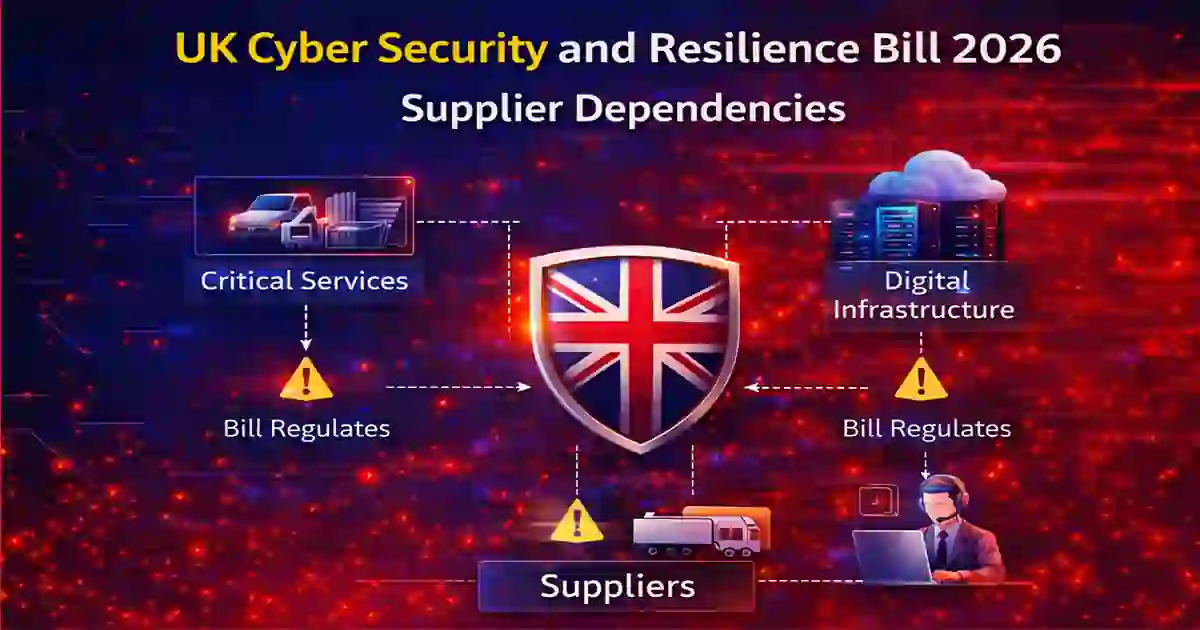
4. Critical Suppliers Could Be Designated
The Bill goes beyond regulating only direct operators.
It introduces a mechanism for critical supplier designation.
The current Parliamentary text expressly identifies designation of critical suppliers as part of the proposed NIS reforms.
The government’s policy position is that suppliers whose disruption could seriously affect regulated essential, digital or managed services may warrant stronger obligations.
Why supplier concentration matters
Imagine that:
- five hospitals;
- two transport operators;
- several utilities
all depend on the same technology vendor.
Each regulated organization may look resilient individually.
But one compromise of that common supplier could create widespread disruption.
That is concentration risk.
Organizations should therefore know:
- which suppliers support critical services;
- how many services depend on each supplier;
- whether subcontractors are involved;
- whether alternative suppliers exist;
- how quickly access can be revoked;
- what evidence suppliers must provide after an incident.
For contract-level controls, use the Cybersecurity Time Supplier Cybersecurity Contract Template.
Supplier Cybersecurity Contract Template
5. Incident Reporting Moves to a 24/72-Hour Model
This is likely to be one of the most operationally important changes.
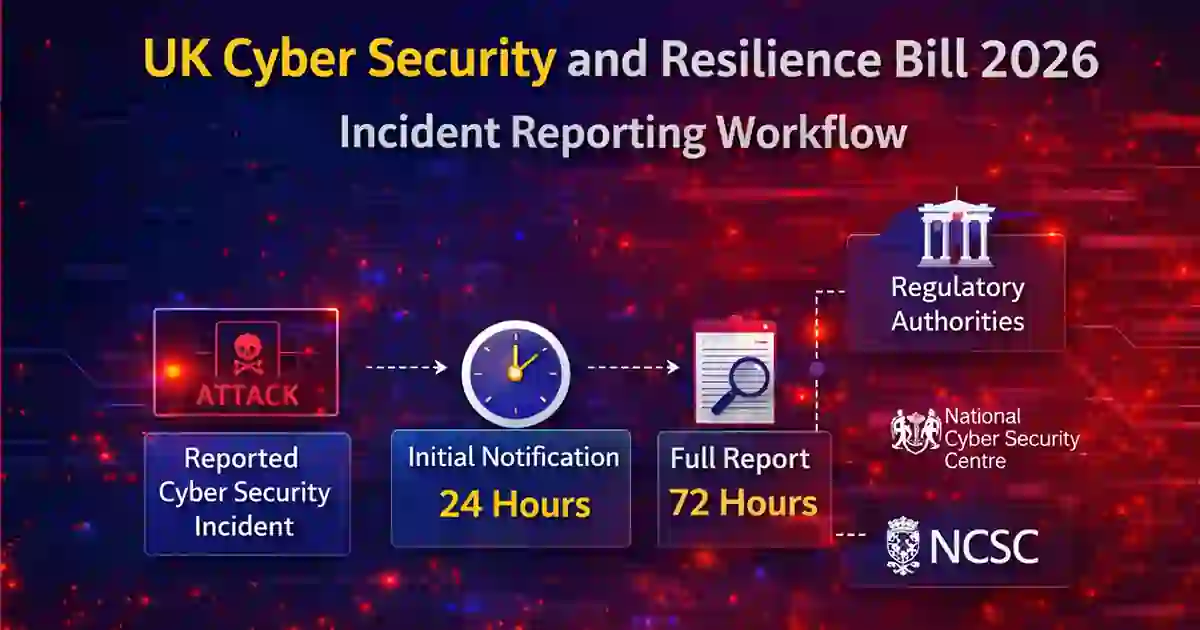
Under the Bill, the reporting model moves toward two main stages:
Initial notification
Within 24 hours of becoming aware that a reportable incident is occurring.
Fuller notification
Within 72 hours of awareness.
The National Cyber Security Centre is to receive notification alongside the relevant regulator.
This approach is designed to provide earlier visibility into serious cyber activity.
What Types of Incidents Could Become Reportable?
The government is attempting to move beyond the current narrow focus on incidents that already cause significant disruption to service continuity.
Government explanations specifically discuss situations such as:
- successful ransomware attacks;
- data exfiltration;
- hostile pre-positioning inside networks;
- serious malicious compromise;
- spyware-related activity,
where significant risk may exist even before obvious service disruption occurs.
That is a major conceptual change.
The regulatory question becomes less:
“Did the service go offline?”
and more:
“Has a significant cyber event occurred that could seriously affect the service or UK interests?”
UK Cyber Incident Reporting Timeline
A practical workflow could look like this:
| Stage | Target |
|---|---|
| Detection | Immediate |
| Validate incident | First hours |
| Assess reportability | As early as possible |
| Initial notification | Within 24 hours of awareness |
| Fuller notification | Within 72 hours of awareness |
| Customer notification where applicable | According to relevant Bill obligations |
| Continued investigation | Ongoing |
The 72-hour report is based on information known at that point; organizations should not wait for a completely finished forensic investigation before reporting.
First 24 Hours: Practical Response Checklist
The new reporting model makes the first hours of an incident particularly important.
0–1 Hour
- open incident record;
- identify incident commander;
- preserve evidence;
- record awareness time;
- determine affected service.
1–4 Hours
Assess:
- service impact;
- data compromise;
- ransomware activity;
- persistence;
- affected customers;
- supplier involvement;
- geographical impact.
4–12 Hours
Bring together:
- security;
- legal;
- compliance;
- operational leadership;
- communications.
Determine whether the event is likely reportable.
12–24 Hours
If reportable:
- prepare initial notification;
- verify competent regulator;
- ensure NCSC receives required information;
- document decisions and assumptions.
For recording this chronology, see Cybersecurity Time’s Data Breach Timeline Template.
Data Breach Timeline Template
Customer Notification Becomes More Important
The Bill also includes customer-notification requirements for relevant categories such as managed-service, digital-service and data-centre providers when customers are likely to have been adversely affected by a reportable incident.
Parliamentary debate specifically highlighted the importance of customers being told when provider compromise may expose their:
- systems;
- services;
- data.
This is important because regulated reporting and customer communication solve different problems.
The regulator needs supervisory visibility.
The customer needs enough information to defend its own environment.
6. Regulators Receive Stronger Enforcement Tools
Scope expansion would have limited value without credible enforcement.
The Bill reforms the existing NIS enforcement framework.
The Bill text includes dedicated provisions concerning:
- enforcement;
- notification of contraventions;
- financial penalties;
- enforcement of penalties;
- appeals.
Government materials also explain that regulators would be able to recover the costs of carrying out their NIS functions, subject to safeguards.
This is intended to create a regulatory framework capable of supporting more organizations and more intensive supervision.
Proposed Penalties Are Significant
The current Bill framework proposes a stronger penalty model.
Published analysis of the Lords Bill records maximum penalties of up to:
- £17 million or 4% of worldwide turnover for the higher band; and
- £10 million or 2% of worldwide turnover for the standard band,
depending on the relevant contravention and statutory framework.
Because the Bill remains under Parliamentary scrutiny, organizations should verify the final enacted penalty structure before relying on these figures as settled law.
The important practical message is still clear:
cyber-resilience compliance is intended to carry meaningful enforcement consequences.
7. Government Gains National-Security Direction Powers
The Bill also includes powers allowing the Secretary of State to intervene where network and information-system threats pose a national-security risk.
The Parliamentary Bill expressly provides powers for directions to:
- regulated persons; and
- regulatory authorities.
This reinforces the Bill’s role as more than ordinary corporate compliance legislation.
It is also part of the UK’s national-resilience and national-security framework.
An organization providing a critical service should therefore ensure cyber-risk escalation reaches leadership capable of handling:
- government directions;
- regulator engagement;
- national-security implications;
- major supplier disruption.
Cybersecurity Time UK Resilience Readiness Matrix
| Area | Current concern | Preparation action |
|---|---|---|
| Scope | New organizations may become regulated | Perform scope assessment |
| MSP exposure | Privileged customer access | Map managed-service dependencies |
| Data centres | Critical hosting concentration | Test resilience and recovery |
| Suppliers | Critical supplier designation | Rank suppliers by systemic impact |
| Reporting | 24/72-hour deadlines | Build reporting workflow |
| Customers | Faster notification expectations | Prepare communication templates |
| Enforcement | Stronger regulator powers | Improve compliance evidence |
| National security | Direction powers | Establish executive escalation |
| Governance | Cross-functional obligations | Create named accountable owners |
This is a practical Cybersecurity Time framework, not an official government checklist.
UK Bill vs EU NIS2
Readers should not assume that the UK Bill simply implements EU NIS2.
It does not.
The United Kingdom’s legislation develops the UK’s existing NIS Regulations 2018, while the EU NIS2 Directive is a separate post-Brexit European framework.
Both systems increasingly emphasize
- essential-service resilience;
- supply-chain security;
- incident reporting;
- management accountability;
- regulatory supervision.
But:
UK requirements and EU NIS2 requirements must be assessed separately.
Multinational organizations should therefore maintain separate jurisdiction mappings.
For European requirements, see Cybersecurity Time’s NIS2 by Country in 2026 guide.
NIS2 by Country in 2026
UK Bill vs EU Cyber Resilience Act
The two regimes also have different primary targets.
UK Cyber Security and Resilience Bill
Primarily focuses on the resilience of:
- essential services;
- digital infrastructure;
- regulated service providers;
- critical suppliers.
EU Cyber Resilience Act
Primarily establishes cybersecurity requirements for products with digital elements placed on the EU market.
The CRA’s reporting obligations started on 11 September 2026, while its main obligations apply from December 2027.
For details, see Cybersecurity Time’s EU Cyber Resilience Act 2026 guide.
EU Cyber Resilience Act 2026
The same company may face both regimes for entirely different reasons.
What Organizations Should Do Before the Bill Becomes Law
Waiting for Royal Assent before beginning preparation may create unnecessary pressure.
Most useful readiness work does not depend on the final wording of every clause.
1. Perform a Scope Assessment
Identify whether you are:
- an operator of essential services;
- digital-service provider;
- MSP;
- data-centre operator;
- load-control provider;
- significant supplier to regulated services.
2. Map Critical Services
For every important service identify:
- system owner;
- infrastructure;
- cloud provider;
- MSP;
- identity provider;
- critical suppliers.
3. Map Supplier Concentration
Ask:
- Which supplier failure could affect multiple critical services?
- Which supplier has privileged access?
- Which supplier would be difficult to replace?
4. Build a 24/72-Hour Reporting Workflow
Do not write it only as a policy.
Run a tabletop exercise.
Example:
At 08:00 the SOC detects suspicious administrator activity in a managed-service environment. At 11:00 investigators confirm ransomware-related lateral movement and evidence that several customer environments may be exposed.
Test:
- who decides reportability;
- who contacts regulator;
- who contacts NCSC;
- who informs customers;
- what can be provided within 24 hours;
- what will be known by 72 hours.
5. Update Supplier Contracts
Critical contracts should address:
- security requirements;
- incident notification;
- evidence sharing;
- audit rights;
- subcontractors;
- recovery expectations;
- termination/exit support.
Use Cybersecurity Time’s supplier-security resources for supporting controls.
Supplier Cybersecurity Contract Template
6. Improve Detection Speed
A 24-hour reporting obligation is difficult to meet if the organization takes two days to recognize a significant attack.
Monitor:
- mean time to detect;
- mean time to investigate;
- mean time to escalate;
- mean time to contain.
See Mean Time to Detect for operational guidance.
Mean Time to Detect
7. Establish Board-Level Reporting
Leadership should receive regular visibility into:
- critical-service risk;
- major suppliers;
- open vulnerabilities;
- incident readiness;
- resilience exercises;
- regulator interactions.
Cybersecurity resilience should be treated as a business-continuity and governance issue rather than solely an IT metric.
Common Preparation Mistakes
Treating the Bill as Already Enacted Law
It is still progressing through Parliament.
Use careful language.
Waiting for Final Legislation Before Doing Anything
Asset, supplier and incident-response improvements are valuable regardless of minor legislative changes.
Focusing Only on Technology
The Bill’s direction clearly involves:
- procurement;
- suppliers;
- reporting;
- governance;
- enforcement.
Buying another security product alone will not create compliance.
Ignoring MSP Privileged Access
Managed-service relationships should be treated as potential privileged trust relationships.
Thinking Only About Outages
The proposed reporting expansion captures serious cyber compromise even when obvious downtime has not yet occurred.
That distinction is particularly important for:
- ransomware;
- espionage;
- pre-positioning;
- data exfiltration.
Waiting for Complete Forensics Before Reporting
The 24/72-hour model is designed around staged reporting.
Organizations should be able to report preliminary known facts while investigation continues.
UK Cyber Resilience Business Checklist
Scope
- Have we assessed whether the Bill may bring us into scope?
- Do we provide managed services?
- Do we operate qualifying data centres?
- Are we a critical supplier candidate?
Governance
- Is there an accountable executive?
- Does the board receive cyber-resilience reporting?
- Is legal/compliance involved in incident planning?
Incident Reporting
- Is awareness time recorded?
- Can we decide reportability rapidly?
- Can we submit an initial report within 24 hours?
- Can we produce a fuller report within 72 hours?
Customers
- Can affected customers be identified quickly?
- Do we have a secure notification channel?
- Are communications templates prepared?
Suppliers
- Are critical suppliers ranked?
- Are notification SLAs contractual?
- Do we know key subcontractors?
- Is replacement/exit planning documented?
Evidence
- Are logs retained?
- Are decisions documented?
- Are exercises recorded?
- Can regulator-facing evidence be produced quickly?
Frequently Asked Questions
Is the Cyber Security and Resilience Bill law yet?
No.
As of September 2026 it remains in Parliament and has progressed into House of Lords scrutiny. Organizations should distinguish clearly between proposed obligations and current legal requirements.
What law does it change?
It primarily reforms and expands the Network and Information Systems Regulations 2018.
Will managed service providers be regulated?
Qualifying relevant managed-service providers are a significant part of the proposed scope expansion.
Will data centres be regulated?
The Bill expressly provides for extending the NIS framework to data centres meeting the relevant definition and thresholds.
What are the proposed cyber-reporting deadlines?
The proposed model uses:
- initial notification within 24 hours of awareness; and
- fuller reporting within 72 hours.
The NCSC is to receive reporting alongside the relevant regulator.
Does reporting apply only when a service goes offline?
The Bill is designed to expand reporting beyond obvious service outages and include significant cyber compromise such as certain ransomware, pre-positioning and other harmful incidents.
Is the Bill the UK’s version of NIS2?
Not exactly.
It reforms the UK’s existing NIS Regulations. EU NIS2 is a separate European Union legal framework.
Companies operating in both the UK and EU should perform separate scope analyses.
Final Takeaway
The Cyber Security and Resilience Bill represents a shift from a relatively narrow essential-service cybersecurity regime toward a broader model of digital operational dependency and resilience.
Its direction can be summarized as:
more entities in scope
greater supplier visibility
24/72-hour reporting
stronger regulator powers
greater national-security coordination
The Bill is still progressing through Parliament, so businesses should avoid presenting every provision as settled law.
But organizations do not need to wait before preparing.
The most valuable work can begin now:
map services → map suppliers → identify privileged dependencies → improve detection → build 24/72-hour reporting → rehearse customer notification → strengthen governance.
The strongest preparation is not predicting the precise date of Royal Assent.
It is ensuring that when new obligations commence, the organization already knows what it depends on, who makes decisions and what evidence it can produce during the first 24 hours of a serious cyber incident.
Primary External Sources
For the final WordPress article, use these authoritative sources:
UK Parliament — Current Cyber Security and Resilience Bill text
GOV.UK — Cyber Security and Resilience Bill factsheets
Network and Information Systems Regulations 2018
The June 2026 government factsheets cover scope expansion, incident reporting, critical suppliers, data centres, MSPs, enforcement, cost recovery and government powers.