Cyber Essentials vs Cyber Essentials Plus: 7 Critical Facts
If you are comparing Cyber Essentials vs Cyber Essentials Plus, you are asking one of the most practical cyber certification questions for UK businesses today. The National Cyber Security Centre says Cyber Essentials is the minimum standard of cyber security recommended by the UK government, while IASME explains that the scheme is built around five technical controls designed to reduce exposure to common internet-based threats. For readers already exploring your site, this topic also fits naturally with your internal Compliance & Reporting coverage.
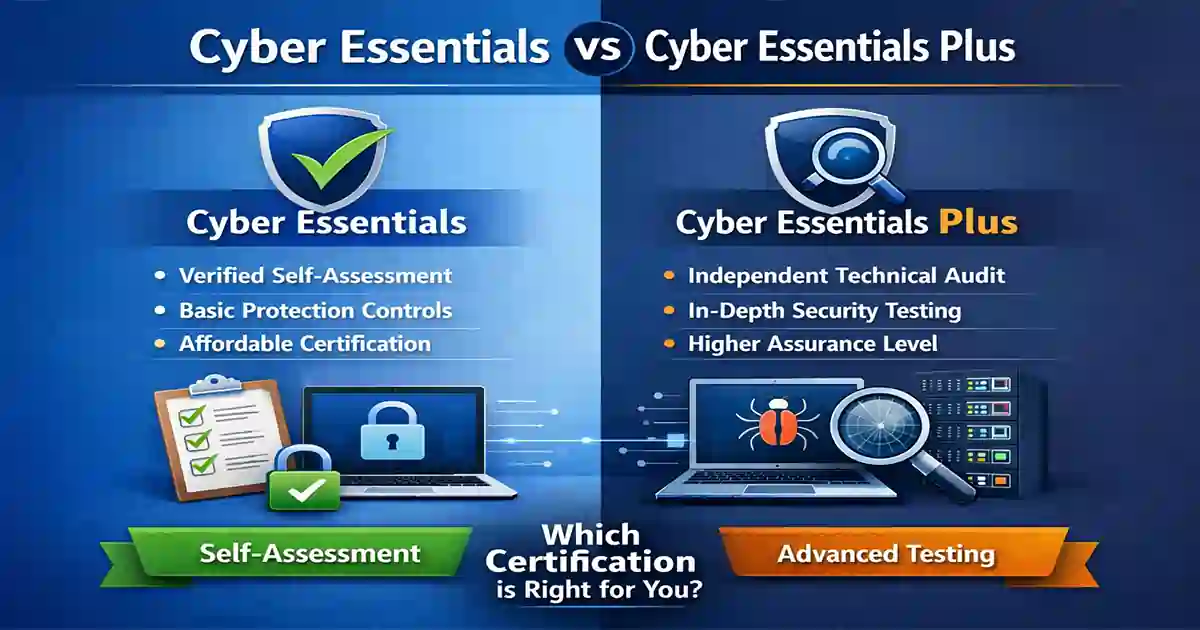
This Cyber Essentials vs Cyber Essentials Plus guide helps UK businesses choose the right certification without wasting time or budget. The core question is simple: do you need a verified self-assessment, or do you need independent technical testing that offers stronger assurance? The NCSC overview says Cyber Essentials uses self-assessment with assessor review, while Cyber Essentials Plus uses the same protections but adds more rigorous independent technical testing. For practical background, you can also connect this article to your internal Cybersecurity Best Practices guide.
The Cyber Essentials vs Cyber Essentials Plus decision matters commercially as well as technically. GOV.UK says an up-to-date Cyber Essentials certificate can enable businesses to bid for some government contracts involving financial or personal data, and the updated PPN 014 Cyber Essentials Scheme says government suppliers bidding for certain public contracts are required to hold Cyber Essentials or Cyber Essentials Plus certification, or demonstrate equivalent controls. That is why this topic is relevant not only for SMEs, but also for MSPs, SaaS vendors, consultancies, and international suppliers serving UK buyers. Internally, this also pairs well with your Cybersecurity Basics hub.
Table of Contents
What is Cyber Essentials?
Cyber Essentials is a UK government-backed, industry-supported certification scheme designed to help organisations protect themselves against common online threats. GOV.UK describes it in those terms, and the NCSC says it is the minimum recommended cyber security standard for organisations of all sizes. For internal readers who want broader context first, this section can naturally point to your What Is Cybersecurity? guide.
According to IASME, the official delivery partner, Cyber Essentials is annually renewable and built around five technical controls. The NCSC requirements document provides the detailed infrastructure rules behind those controls, including guidance on cloud services, devices, VPNs, and scope. For supporting internal reading, you can link here to Essential Cybersecurity Tools.
The standard Cyber Essentials route is not just a casual questionnaire. The NCSC overview says it combines self-assessment with independent review by an assessor, which makes it more credible than an informal internal checklist even though it is still less rigorous than Plus. This also works well as an internal bridge to your Cybersecurity Best Practices article.
What is Cyber Essentials Plus?
Cyber Essentials Plus is the higher-assurance version of the same scheme. The NCSC says it uses the same protections as Cyber Essentials but adds more rigorous independent technical testing. That means the difference is not a different philosophy, but a different level of validation. For internal support, this section can also link to your Information Security Guide.
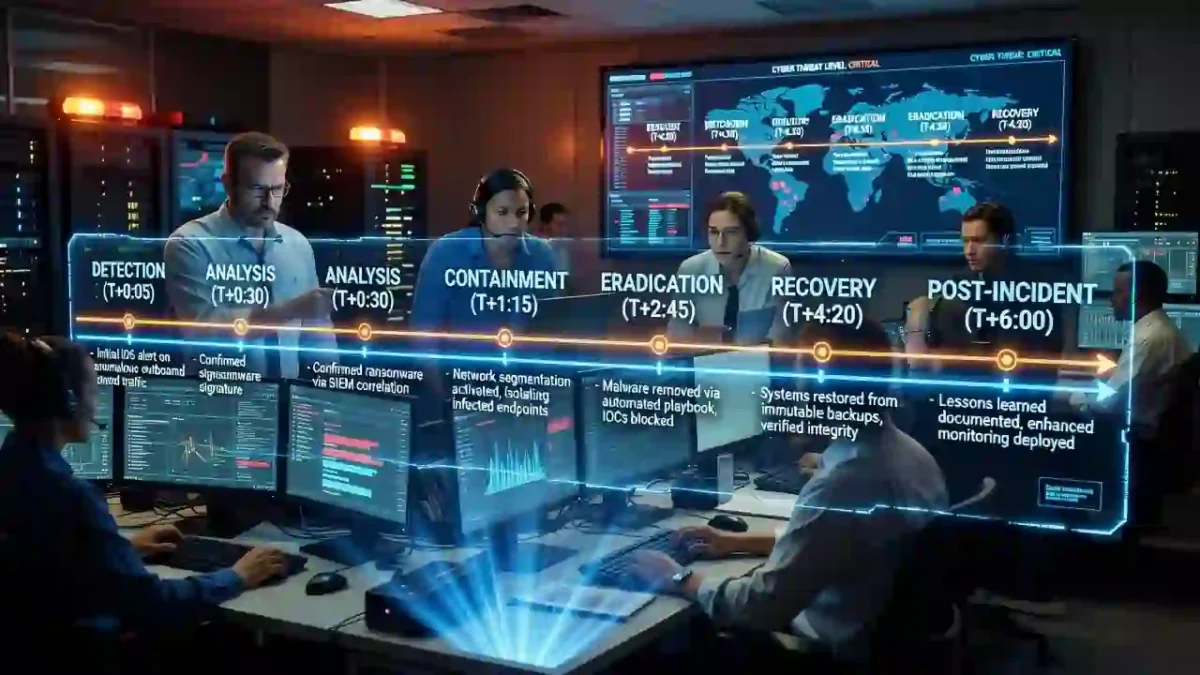
Cyber Essentials Plus builds on the standard scheme rather than replacing it. IASME’s April 2026 update says CE+ provides a higher level of assurance because it includes a technical audit of an organisation’s cyber security measures, and IASME also notes that organisations needing Plus must work directly with a certification body. For related operational context, you can point readers to your internal Cybersecurity Incident Response Timeline.
For many organisations, the Cyber Essentials vs Cyber Essentials Plus comparison becomes more important when customers, procurement teams, or sector rules demand stronger proof that the controls actually work in practice. That is an inference based on the higher-assurance structure of Plus, the public-sector procurement guidance, and the NCSC’s description of more rigorous testing. This paragraph also pairs well with your internal Cybersecurity Time: 7 Powerful Ways to Reduce Cyber Risk article.
Cyber Essentials vs Cyber Essentials Plus: Main Difference
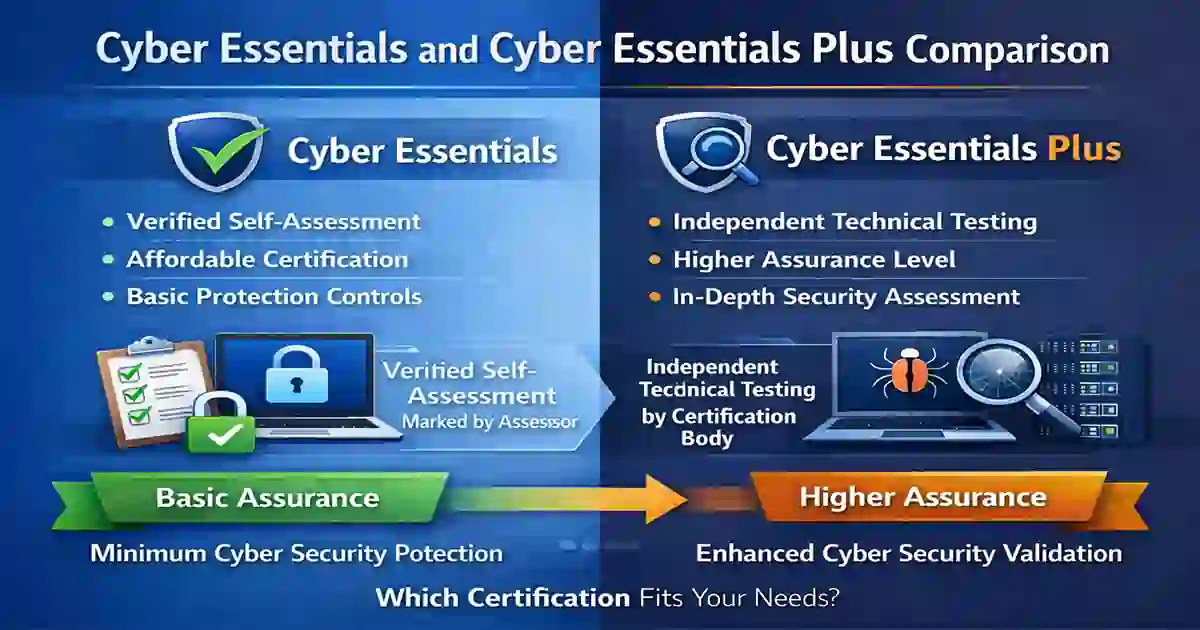
The biggest difference in Cyber Essentials vs Cyber Essentials Plus is the verification method. With Cyber Essentials, your organisation completes a verified self-assessment and an assessor reviews it. With Cyber Essentials Plus, the same core protections are checked through a more rigorous technical assessment. This section can also support an internal link to your Compliance & Reporting category.
In practical terms, Cyber Essentials shows that your organisation has declared the right baseline controls and passed scheme review. Cyber Essentials Plus shows that those controls have been tested more deeply by an external certification body. That is why many organisations begin with Cyber Essentials, while others move directly to Plus because of customer expectations, supply-chain pressure, or internal risk appetite. For internal readers, this also aligns with your Board-Level Cybersecurity Metrics Guide.
For many organisations, the Cyber Essentials vs Cyber Essentials Plus decision depends on the level of assurance customers and regulators expect. If the goal is a practical baseline certification, Cyber Essentials may be enough. If the goal is stronger external proof, Cyber Essentials Plus is usually the better signal. That inference is grounded in the NCSC overview, the IASME scheme guidance, and the government procurement note. Internally, this also connects well to Cybersecurity Best Practices.
7 Critical Facts About Cyber Essentials vs Cyber Essentials Plus
1. Assessment method
Cyber Essentials relies on a verified self-assessment marked by an assessor, while Cyber Essentials Plus adds independent technical testing through a certification body. This is the clearest technical difference in Cyber Essentials vs Cyber Essentials Plus. For an internal companion read, use Compliance & Reporting.
2. Level of assurance
Cyber Essentials gives a credible baseline certification, but Cyber Essentials Plus offers higher assurance because the controls are tested more deeply. IASME states that directly in its 2026 update. Internally, this section can also point to Information Security Guide.
3. Cost
The NCSC overview says Cyber Essentials pricing starts at £320 plus VAT for the standard certification and varies by organisation size, while Cyber Essentials Plus pricing depends on the size and complexity of the network. In practice, that means Plus is usually more expensive. For internal context, this also fits with Essential Cybersecurity Tools.
4. Route to certification
IASME says organisations can take a self-led or supported route for Cyber Essentials, but if they require Plus, they must work with a certification body directly. That makes the buying path different even before the assessment starts. For internal linking, this can connect to Cybersecurity Basics.
5. Contract and customer expectations
GOV.UK says an up-to-date Cyber Essentials certificate can enable a business to bid for government contracts involving financial or personal data, and the 2025 procurement policy note reinforces the role of Cyber Essentials and Plus in supply-chain controls. In practice, Plus may be preferred when customers want stronger proof of control effectiveness. Internally, this also suits your Compliance & Reporting structure.
6. Preparation effort
Cyber Essentials still requires careful preparation, but Cyber Essentials Plus usually demands a cleaner and more mature environment because technical testing can reveal weaknesses more clearly than the standard route. That inference is supported by NCSC’s description of Plus as more rigorous. A useful internal link here is Cybersecurity Incident Response Timeline.
7. Best fit
Cyber Essentials is often the right fit for organisations that want an affordable baseline certification. Cyber Essentials Plus is often a better fit for organisations that need stronger external assurance, tighter procurement positioning, or a more persuasive trust signal for larger customers. That is an inference based on the scheme structure and intended use. Internally, this can point to What Is Cybersecurity?.
Which Certification Should You Choose?
Choose Cyber Essentials if your main goal is to demonstrate baseline cyber hygiene, meet a common supplier requirement, or start with a lower-cost certification route. The NCSC presents it as the minimum recommended standard, and IASME offers both self-led and supported paths. For internal readers, this section can also point to Cybersecurity Best Practices.
Choose Cyber Essentials Plus if you need stronger external proof that your controls are actually working, or if your customers, procurement process, or sector expects deeper assurance. Because Plus involves more rigorous testing, it is usually the better option for organisations facing tighter scrutiny. Internally, this also works with Essential Cybersecurity Tools.
The Cyber Essentials vs Cyber Essentials Plus choice becomes easier when you compare cost, testing, and business risk side by side. A sensible route for many SMEs is to prepare properly, achieve Cyber Essentials first, and then move to Plus if market demand or internal risk appetite justifies it. Another good route is to speak to a certification body early if you already know independent testing will be required. The IASME page and NCSC resources page both support that path. For internal depth, link here to Cybersecurity Time.
2026 Update You Should Not Ignore
If you are preparing this year, the April 2026 changes matter. IASME says the five core controls remain unchanged, but the update tightens interpretation, marking, and elements of the Cyber Essentials Plus methodology. IASME also says organisations that fail to implement MFA for cloud services where it is available will automatically fail the updated assessment. Internally, this section fits neatly with Compliance & Reporting.
IASME also says these changes apply to assessment accounts created after late April 2026, while applicants have six months from account creation to complete the assessment. That makes timing important for organisations currently planning certification or recertification. For internal support, also link this section to Information Security Guide.
Final Verdict
When comparing Cyber Essentials vs Cyber Essentials Plus, the right choice depends on the level of assurance your organisation needs. Choose Cyber Essentials if you want a credible, government-backed baseline certification that is easier and cheaper to achieve. Choose Cyber Essentials Plus if you need stronger independent proof, deeper testing, and a more persuasive certification for customers and procurement teams. For internal support, this conclusion also pairs well with Cybersecurity Best Practices.
For many UK organisations, Cyber Essentials is the sensible first step. But if trust, auditability, and competitive differentiation matter more than speed and cost, Cyber Essentials Plus is often the smarter long-term choice. The Cyber Essentials vs Cyber Essentials Plus decision is rarely about prestige alone. It is about choosing the assurance level that matches your contracts, customers, and risk exposure. Internally, you can finish by pointing readers to Compliance & Reporting and your homepage.
FAQ
Is Cyber Essentials enough for most small businesses?
Often, yes. The NCSC positions Cyber Essentials as the minimum recommended cyber security standard for organisations of all sizes. For internal reading, add Cybersecurity Basics.
Is Cyber Essentials Plus better than Cyber Essentials?
It provides higher assurance because it includes more rigorous independent technical testing. Whether it is better depends on your business needs, budget, and customer expectations, as described by the NCSC overview. Internally, this can also link to Information Security Guide.
Does Cyber Essentials need to be renewed?
Yes. IASME says Cyber Essentials certification is valid for 12 months and must be renewed annually. A natural internal link here is Compliance & Reporting.
Can Cyber Essentials help with government contracts?
Yes. GOV.UK says an up-to-date Cyber Essentials certificate can enable a business to bid for government contracts where handling financial or personal data is involved. Internally, this can point to Cybersecurity Best Practices.
Is Cyber Essentials vs Cyber Essentials Plus a common decision for UK SMEs?
Yes. Cyber Essentials vs Cyber Essentials Plus is one of the most common certification comparisons for UK SMEs, suppliers, and service providers deciding how much assurance they need. That is an inference based on how the NCSC, IASME, and current government procurement guidance position the two certification paths. Internally, this also works with Cybersecurity Basics