
Average Cyber Attack Detection Time in 2026: Latest Statistics and Benchmarks
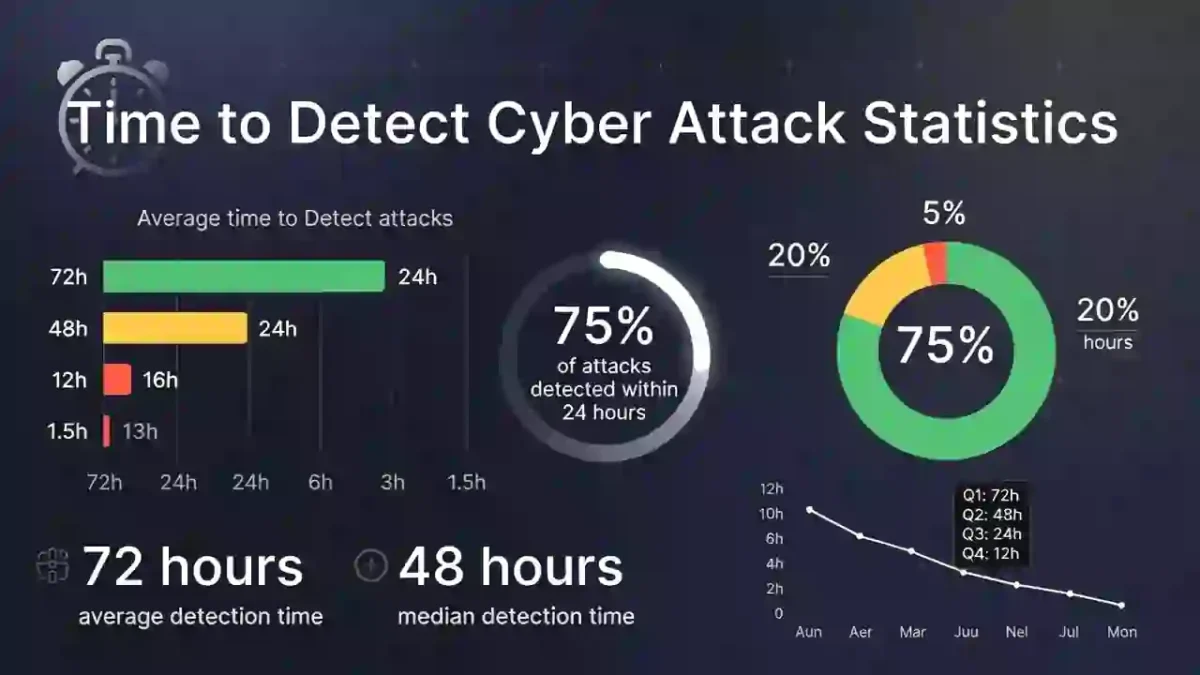
The average time to detect a cyber attack is one of the most commonly discussed cybersecurity performance measures—but it is also one of the most frequently misunderstood.
There is no single authoritative global number that tells every organization:
“The average cyber attack takes X days to detect.”
Different research reports measure different things.
Some measure:
- dwell time;
- incident discovery;
- time to identify;
- time to contain;
- Mean Time to Detect (MTTD);
- combined identify-and-contain lifecycle.
Those numbers should not be treated as interchangeable.
For example, Mandiant’s M-Trends 2026 reports a global median dwell time of 14 days across its 2025 incident-response investigations. IBM’s 2025 Cost of a Data Breach reporting, by contrast, says organizations took an average of 241 days to identify and contain a breach. These are fundamentally different measurements.
The better question is therefore:
What exactly is being measured, and how does that statistic relate to my own detection performance?
Cyber Attack Detection Statistics at a Glance
| Statistic | Latest figure | What it actually means |
|---|---|---|
| Mandiant global median dwell time | 14 days | Median attacker presence before discovery across Mandiant 2025 investigations |
| Mandiant internal discovery | 52% | Incidents first detected internally |
| External notification | 34% | Incidents first revealed by another entity |
| Adversary notification | 14% | Incidents revealed by attacker activity/notification |
| IBM identify + contain lifecycle | 241 days | Combined time to identify and contain a breach |
| MTTD | Organization-specific | Average detection interval based on your own definition |
These figures should not be combined into one “industry average.”cally expect.
Table of Contents
What Does “Average Time to Detect a Cyber Attack” Actually Mean?
The phrase can refer to several different metrics.
Mean Time to Detect
Mean Time to Detect (MTTD) is an internal cybersecurity metric.
A simplified formula is:
MTTD = Total Detection Time ÷ Number of Incidents
The starting point must be defined consistently.
For example:
first confirmed malicious activity → detection
For a full explanation, see Mean Time to Detect (MTTD).
Dwell Time
Dwell time usually refers to how long an attacker remains present in an environment before being discovered.
A simplified representation is:
Dwell Time = Discovery Time − Initial Compromise Time
Mandiant uses dwell time extensively in its annual M-Trends research.
Its 2026 report found that global median dwell time increased to 14 days, compared with 11 days in the previous reporting period.
For the dedicated explanation, see Dwell Time Cybersecurity.
Identify-and-Contain Time
IBM uses another measurement.
Its 2025 Cost of a Data Breach reporting says organizations were able to identify and contain a breach in a mean time of 241 days, the lowest figure in nine years.
That is useful research.
But it should not be rewritten as:
“Average cyber attack detection time is 241 days.”
Why?
Because IBM is measuring the combined lifecycle:
identify + contain
not simply detection.
Why Median and Mean Are Different
Another common problem is mixing averages and medians.
Suppose five incidents have detection intervals of:
1 hour, 2 hours, 3 hours, 4 hours, 100 days
The arithmetic mean becomes heavily influenced by the one extreme incident.
The median remains much closer to the typical case.
This is why Mandiant reports median dwell time, while other organizations may report means.
Never compare:
mean detection time
directly with:
median dwell time
without explaining the difference.
What M-Trends 2026 Shows
Mandiant’s M-Trends 2026 is one of the most useful current datasets for understanding attacker discovery timelines.
The report is based on Mandiant Consulting investigations conducted between January 1 and December 31, 2025.
Its main detection-related findings include:
- global median dwell time increased to 14 days;
- the previous reporting period was 11 days;
- organizations first detected malicious activity internally 52% of the time;
- external entities notified organizations 34% of the time;
- adversaries informed victims 14% of the time.
These numbers provide much stronger evidence than a generic claim such as:
“Most organizations take 200 days to detect attackers.”
Some Attackers Remain Hidden Far Longer
The 14-day median does not mean every attacker is found in two weeks.
Mandiant reports that certain threat actors remained present far longer, especially those focused on espionage and stealth.
In its 2025 investigations, both cyber-espionage and DPRK IT-worker activity had median dwell times of 122 days.
Mandiant also observed cases involving extremely long-term persistence, including compromises lasting over a year.
That is important because an overall median can hide long-tail risk.
Other Attacks Move in Seconds
At the opposite extreme, some attacks escalate extraordinarily quickly.
Mandiant says initial-access actors sometimes hand access to another criminal group in less than 30 seconds.
This creates a major challenge for defenders:
some attackers hide for months
while:
others escalate almost immediately.
That is why one universal detection benchmark is not particularly useful.
Internal vs External Detection
One of the most useful statistics in M-Trends 2026 is who discovers the breach.
Across Mandiant’s 2025 investigations:
52% — internally detected
34% — external entity notification
14% — adversary notification
This gives organizations a useful internal metric:
What percentage of our serious incidents do we detect ourselves?
A mature SOC should generally want internal detection to increase over time.
Ransomware Has a Different Discovery Pattern
Ransomware behaves differently because attackers often need victims to know an attack occurred.
Mandiant reports that for ransomware cases:
- adversaries notified targets 44% of the time;
- victims identified the activity internally 41% of the time;
- external entities notified victims 15% of the time.
That means ransomware detection statistics should not be treated the same as espionage statistics.
Attack objectives influence discovery patterns.
Why Cyber Attack Detection Still Takes Too Long
Several recurring problems contribute to long detection windows.
1. Edge-Device Blind Spots
Mandiant specifically highlights persistent attacker activity on edge devices that often lack standard endpoint telemetry.
Examples may include:
- VPN appliances;
- firewalls;
- virtualization infrastructure;
- network devices.
If telemetry is missing, the SOC cannot detect what it cannot see.
2. Identity-Based Attacks
Attackers increasingly abuse:
- valid credentials;
- administrator accounts;
- tokens;
- legitimate tools.
These techniques can blend with normal activity and make traditional malware-only detection ineffective.
3. Logging Gaps
Mandiant notes that limited logging and short retention periods can prevent responders from reconstructing older intrusion activity.
An organization may discover the breach today but be unable to determine whether initial access occurred:
- two weeks ago;
- six months ago;
- a year ago.
That directly affects dwell-time measurement.
4. Alert Fatigue
A SOC may technically receive the right alert while still failing to investigate it promptly.
This creates a distinction between:
machine detection
and:
human acknowledgement.
That is why organizations should also measure:
- Mean Time to Acknowledge;
- validation time;
- queue age.
5. Third-Party Discovery
Some incidents are first found by:
- cloud providers;
- customers;
- security researchers;
- suppliers;
- law enforcement.
External discovery may indicate visibility gaps inside the organization.
Cybersecurity Time Detection Measurement Model
A useful timeline separates several events:
| Event | Example |
|---|---|
| Initial compromise | 01:00 |
| First observable malicious activity | 02:10 |
| Security alert generated | 02:15 |
| Analyst acknowledges | 02:21 |
| Incident validated | 02:40 |
| Effective containment | 03:30 |
From those timestamps you can calculate several metrics:
Dwell time
Detection latency
MTTA
Validation time
MTTC
One number cannot describe the whole incident.
Average Detection Time vs MTTD
The phrase average detection time sounds equivalent to MTTD, but public research frequently uses different methodologies.
Your organization’s MTTD should be based on your own incident dataset.
For example:
| Incident | Detection interval |
|---|---|
| A | 15 min |
| B | 35 min |
| C | 2 hrs |
| D | 20 min |
MTTD:
15 + 35 + 120 + 20 = 190 minutes
190 ÷ 4 = 47.5 minutes
That is your internal MTTD.
It should not be compared directly with Mandiant’s 14-day median dwell-time figure.
Why P90 Detection Time Matters
Suppose:
Median detection time = 18 minutes
MTTD = 32 minutes
This looks strong.
But:
P95 detection time = 18 hours
That means a small number of incidents still remain undetected for much longer.
Those are often the incidents worth investigating most closely.
Track:
- mean;
- median;
- P90;
- P95;
- maximum.
There Is No Universal Good Detection Time
Your current article needs to avoid claims such as:
“Advanced organizations detect attacks in under 30 days.”
That is far too broad.
A reasonable target depends on the attack.
For example:
Active ransomware execution
Detection should ideally happen in minutes.
Privileged account takeover
Minutes may also matter.
Long-term espionage
The attacker may deliberately avoid obvious indicators.
Low-risk suspicious behavior
A slower response may be tolerable.
A useful target is therefore:
risk-based detection time
rather than:
one number for every event.
Detection Benchmarks Should Be Based on Severity
An organization might establish internal goals such as:
| Severity | Illustrative detection target |
|---|---|
| Critical | <15 min |
| High | <30 min |
| Medium | <4 hrs |
| Low | Risk-based |
These are illustrative targets, not universal benchmarks.
Your organization should set them according to:
- business risk;
- system criticality;
- attack speed;
- telemetry coverage;
- staffing.
Detection Benchmarks Should Also Be Based on Attack Type
| Attack type | What to measure |
|---|---|
| Ransomware | Execution → detection |
| Identity compromise | Unauthorized login → detection |
| Cloud takeover | Malicious cloud action → detection |
| Data exfiltration | Transfer begins → detection |
| Third-party incident | Supplier notification → internal validation |
| Edge-device compromise | First observable activity → discovery |
This makes detection metrics actionable.
Why Industry-Specific “Average Detection Times” Are Risky
Your existing Finance / Healthcare / Manufacturing section currently makes general claims such as:
- finance typically detects faster;
- healthcare often detects slower;
- manufacturing is frequently affected by delayed ransomware detection.
Those observations may sometimes be directionally plausible, but they should not be presented as universal detection benchmarks without a source using consistent methodology.
A stronger article should say:
industry, architecture, security maturity and attacker objectives can influence detection performance, but broad sector averages should only be used when the underlying methodology is clear.
That avoids unsupported statements.
What IBM’s 241 Days Actually Means
IBM’s latest reporting is useful—but it needs the correct label.
IBM states that organizations identified and contained breaches in a mean time of 241 days in its 2025 report.
That is a breach-lifecycle statistic.
It is not:
- Mean Time to Detect alone;
- median attacker dwell time;
- a universal 2026 detection benchmark.
Use it to discuss the total breach lifecycle, not simply detection.
How to Reduce Cyber Attack Detection Time
1. Improve Telemetry Coverage
Monitor:
- endpoints;
- identity;
- cloud;
- network infrastructure;
- SaaS;
- virtualization;
- edge systems.
Mandiant’s 2026 findings particularly reinforce the need to monitor systems outside traditional endpoint coverage.
2. Extend Log Retention Where Risk Requires It
Long-lived intrusions can exceed short log-retention periods.
Retention should reflect:
- threat model;
- regulatory requirements;
- investigation needs;
- storage cost.
Do not retain everything forever without reason, but avoid making investigations impossible through overly short retention.
3. Improve Identity Detection
Monitor:
- suspicious privileged activity;
- unusual session behavior;
- token abuse;
- MFA changes;
- administrative role changes.
4. Improve Alert Correlation
A modern intrusion may create several weak signals.
Example:
new device + unusual login + privilege change + large download
Correlation can reveal the bigger pattern.
5. Reduce Alert Noise
More alerts can make detection slower if analysts cannot prioritize them.
Track:
- false-positive rate;
- queue age;
- time to acknowledge;
- incident conversion.
6. Monitor Edge and Virtualization Infrastructure
Traditional endpoint agents may not cover:
- hypervisors;
- VPN appliances;
- network devices.
Mandiant specifically warns about adversaries taking advantage of these visibility gaps.
7. Run Detection Exercises
Test whether security controls detect:
- ransomware;
- credential theft;
- cloud takeover;
- lateral movement;
- exfiltration.
For a deeper implementation guide, see How to Reduce Cybersecurity Detection Time.
Detection Time and Incident Response
Detection is only the first defensive milestone.
The full sequence is:
Attack
↓
Detection
↓
Validation
↓
Containment
↓
Eradication
↓
Recovery
NIST’s current SP 800-61 Rev. 3 integrates detection, response and recovery across cybersecurity risk management and supersedes Rev. 2.
For the operational workflow, see Cybersecurity Incident Response Timeline.
Detection Time vs Containment Time
Suppose:
Attack begins: Monday
Detection: Friday
Containment: 10 minutes later
The response team contained the attacker very quickly.
But the attacker still had several days of dwell time.
Now reverse the situation:
Attack begins: 10:00
Detection: 10:05
Containment: 16:00
Detection was excellent.
Containment was poor.
For the full metric comparison, see MTTD vs MTTR vs MTTC vs Dwell Time.
Detection Time and Regulatory Reporting
Detection time can influence regulatory readiness, but operational detection metrics are not automatically regulatory clocks.
For example:
- SEC reporting depends on materiality determination;
- UK GDPR depends on awareness of a reportable personal-data breach;
- other regimes use different triggers.
Therefore, do not assume:
Security detected attack at 09:00 → every legal clock begins at 09:00.
Your incident chronology should record separate timestamps.
For a regulatory comparison, see Cyber Incident Reporting Deadlines: US vs UK.
Cybersecurity Time Detection Dashboard
A stronger internal dashboard might track:
| Metric | Current |
|---|---|
| MTTD | 34 min |
| Median detection | 19 min |
| P90 detection | 2.3 hrs |
| P95 detection | 7.4 hrs |
| Internal discovery | 84% |
| External discovery | 16% |
| Critical MTTD | 8 min |
| Cloud MTTD | 52 min |
| Edge-device MTTD | 6.7 hrs |
These values are illustrative.
The purpose is to identify weak areas rather than chase a universal industry average.
Questions CISOs Should Ask
A useful detection review should ask:
- What percentage of major incidents do we detect ourselves?
- Which assets have no meaningful telemetry?
- What is our median detection time?
- What is our P95?
- Which incident type has the longest MTTD?
- Which detection source generates the slowest alerts?
- Are supplier incidents usually discovered externally?
- Do we retain logs long enough to investigate stealthy intrusions?
Those questions produce more useful answers than:
“Are we better than the global average?”
Frequently Asked Questions
What is the average time to detect a cyber attack in 2026?
There is no single universally valid average.
Mandiant’s M-Trends 2026 reports a global median dwell time of 14 days across its 2025 investigations, while other studies use different metrics and methodologies.
Is 241 days the average time to detect a breach?
No.
IBM reports a mean 241 days to identify and contain a breach in its 2025 Cost of a Data Breach research. That combines identification and containment and should not be labeled simply as detection time.
What is dwell time?
Dwell time generally describes how long an attacker remains in an environment before discovery or detection.
What is MTTD?
Mean Time to Detect is an organization-defined average detection interval across incidents.
Are MTTD and dwell time the same?
No.
They overlap conceptually but are used differently.
MTTD is commonly an internal operational metric.
Dwell time is often used in threat-research and incident-response datasets.
What percentage of incidents are detected internally?
Mandiant reports that organizations first detected malicious activity internally in 52% of its 2025 investigations.
That is a statistic from Mandiant’s investigation dataset, not a universal figure for every organization.
Why do attackers stay undetected?
Common reasons include:
- telemetry gaps;
- identity abuse;
- edge-device blind spots;
- poor log retention;
- alert fatigue;
- stealthy use of legitimate tools.
Is NIST SP 800-61 Rev. 2 still current?
No.
NIST finalized SP 800-61 Rev. 3 in April 2025, and Rev. 3 supersedes Rev. 2.
Final Takeaway
There is no trustworthy universal number for the “average time to detect a cyber attack.”
The most useful current statistics tell different parts of the story:
Mandiant M-Trends 2026:
14-day global median dwell time across its 2025 investigations.
Mandiant discovery source:
52% internal / 34% external / 14% adversary notification.
IBM 2025 Cost of a Data Breach:
241-day mean identify-and-contain lifecycle.
These metrics should not be merged into one “average detection” figure.
For organizations, the stronger approach is to measure their own:
MTTD + median + P90/P95 + dwell time + internal/external discovery
and segment those results by:
- severity;
- attack type;
- system;
- detection source.
Current threat research shows why this matters. Some attackers maintain stealth for months, while others hand access to secondary criminal groups in less than 30 seconds.
The most useful question is therefore not:
“What is the worldwide average detection time?”
It is:
“Which attacks remain invisible in our environment, for how long, and why?”
t use Wikipedia for breach-statistics claims.
Recommended Internal Links:
MTTD vs MTTR vs MTTC vs Dwell Time