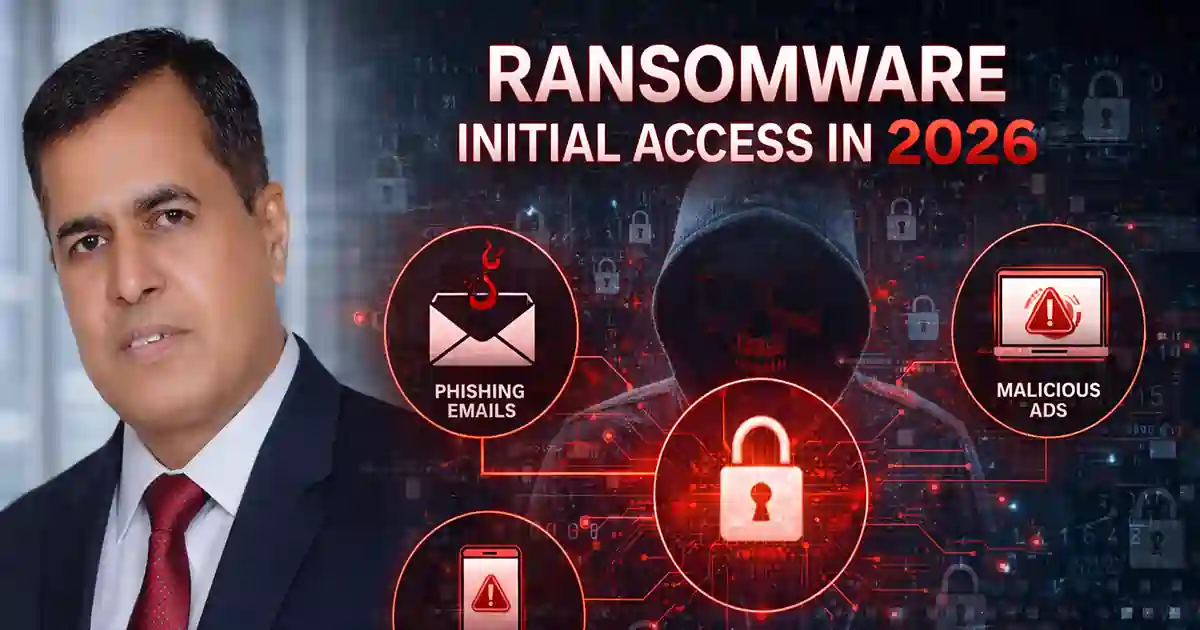
Ransomware Initial Access in 2026: 12 Risks Security Teams Should Prioritize
Ransomware initial access in 2026 is no longer best understood as a phishing-only problem.
Attackers increasingly combine stolen credentials, vulnerable internet-facing systems, VPN exploitation, exposed remote services, social engineering, session theft, malicious downloads, cloud identity abuse, and trusted third-party access to establish an initial foothold.
Current threat reporting supports this broader picture.
Google Threat Intelligence Group reported in March 2026 that exploitation or suspected exploitation of vulnerabilities accounted for one-third of the ransomware incidents Mandiant investigated in 2025, with attackers frequently targeting common VPN and firewall products. Compromised legitimate credentials were used in 21% of intrusions where the initial access vector was identified.
Microsoft’s 2025 Digital Defense Report similarly found that phishing/social engineering, unpatched web assets, and exposed remote services remained important entry points. Microsoft also highlighted the growing role of access brokers, infostealers, identity abuse, and device-code phishing.
Verizon’s 2025 DBIR research found that compromised credentials were an initial access vector in 22% of the breaches reviewed, reinforcing how important identity security remains.
The lesson for defenders is simple:
Ransomware prevention has to start before encryption.
The highest-value opportunity is often the moment an attacker is trying to gain or stabilize that first foothold.
Executive Summary
The most important ransomware initial-access risks in 2026 include:
| Risk | Why it matters | Defensive priority |
|---|---|---|
| Stolen credentials | Valid accounts can look legitimate | Critical |
| Session/token theft | Can bypass repeated login challenges | Critical |
| Edge-device exploitation | VPNs/firewalls are internet-facing and trusted | Critical |
| Exposed remote services | RDP, VPN, SSH and admin tools create direct paths | Critical |
| Help-desk social engineering | Human workflows can bypass strong technical controls | High |
| Malvertising/fake installers | Users may install credential stealers or remote tools | High |
| ClickFix/social engineering | Victims are tricked into executing commands | High |
| Known exploited vulnerabilities | Attackers are already using them | Critical |
| Third-party access | Trusted vendor connectivity can become inherited risk | High |
| Initial-access brokers | Criminals can simply buy access | High |
| Cloud identity abuse | One identity may expose email, apps and data | Critical |
| Slow detection | Turns limited access into a larger compromise | Critical multiplier |
These risks overlap. A ransomware intrusion may begin with stolen credentials, continue through a VPN login, escalate through an exposed vulnerability, and remain unnoticed because the activity resembles legitimate administration.
Table of Contents
What Is Ransomware Initial Access?
Ransomware initial access is the stage where an attacker first establishes a usable foothold inside an organization’s environment.
That foothold may come from:
- a compromised username and password;
- a stolen session token;
- an internet-facing vulnerability;
- a VPN account;
- an exposed Remote Desktop Protocol service;
- a malicious software installer;
- social engineering;
- a cloud identity;
- a trusted vendor connection;
- access purchased from an initial-access broker.
Initial access does not mean the attacker has already deployed ransomware.
In many intrusions, the first foothold is only the beginning.
From there, attackers may attempt to:
- establish persistence;
- escalate privileges;
- discover systems and accounts;
- move laterally;
- disable security tools;
- compromise backups;
- steal data;
- deploy ransomware or conduct extortion.
For the later phases of the intrusion lifecycle, Cybersecurity Time’s Ransomware Detection Timeline provides a useful operational companion.
Why Ransomware Initial Access Is Changing
Three developments are reshaping the initial-access landscape.
Identity abuse has become central
Attackers increasingly want valid identities, not just malware execution.
Microsoft reports that identity-based attacks increased in the first half of 2025 and describes attackers targeting both human and workload identities. Its report highlights OAuth consent phishing, device-code phishing, compromised applications, and token-based access as important identity risks.
A legitimate account can be especially valuable because activity performed with it may initially resemble normal user behavior.
Internet-facing infrastructure remains heavily targeted
Google Threat Intelligence Group found that vulnerability exploitation was the most commonly identified initial-access vector in the ransomware incidents Mandiant examined during 2025.
Attackers repeatedly targeted VPNs and firewalls from vendors including Fortinet, SonicWall, Palo Alto Networks, and Citrix.
That makes patching exposed edge infrastructure a ransomware-defense issue—not just a vulnerability-management task.
For more detailed remediation guidance, see Cybersecurity Time’s VPN and Edge Security Vulnerabilities to Prioritize.
Cybercrime is increasingly specialized
Attackers do not always need to compromise a victim themselves.
Microsoft describes a cybercrime ecosystem in which access brokers sell credentials and established footholds into organizations, allowing ransomware operators and other criminals to purchase access rather than develop it independently.
This specialization makes ransomware operations more scalable.
1. Stolen Credentials
Priority: Critical
Compromised credentials remain one of the most effective ways for attackers to enter business environments.
Verizon reports that compromised credentials were used as an initial access vector in 22% of breaches examined in the 2025 DBIR.
Google Threat Intelligence Group also observed compromised legitimate credentials in about 21% of ransomware intrusions where the initial access vector was identified. Attackers commonly used those credentials to authenticate to VPN or RDP services.
Credentials can come from:
- infostealer malware;
- phishing;
- password reuse;
- credential stuffing;
- exposed databases;
- underground marketplaces;
- previous unrelated breaches;
- compromised personal devices.
Why it matters
A valid login often generates fewer obvious warning signs than malware exploitation.
If attackers authenticate successfully using a legitimate account, defenders may initially see only:
successful login → normal protocol → valid username.
The malicious intent may become obvious only later.
Recommended controls
- deploy phishing-resistant MFA for high-risk accounts;
- disable unused identities;
- monitor impossible-travel events;
- detect new devices and unusual source networks;
- reduce password reuse;
- block legacy authentication;
- review leaked-credential exposure;
- monitor infostealer activity.
For additional context, see Info Stealer Malware in 2026.
2. Session and Token Theft
Priority: Critical
Attackers increasingly target authenticated sessions and tokens rather than relying solely on passwords.
A stolen session can sometimes allow an attacker to operate as a user who has already completed authentication.
Microsoft’s reporting highlights attacks involving device-code phishing, malicious OAuth consent, access tokens, and refresh tokens. These techniques can enable persistent access to email, cloud storage, and other resources without requiring the attacker to repeatedly present the victim’s password.
Why it matters
Traditional MFA works best when an attacker must complete a fresh authentication challenge.
If the attacker steals or obtains a valid authenticated token, the defensive problem becomes more complicated.
Recommended controls
- use phishing-resistant MFA;
- shorten high-risk session lifetimes;
- monitor token replay and unusual device use;
- review OAuth application consent;
- restrict user consent where appropriate;
- revoke sessions during incident response;
- monitor risky sign-ins and impossible travel.
Cybersecurity Time’s Phishing-Resistant MFA Checklist provides additional guidance.
3. VPN and Edge-Device Exploitation
Priority: Critical
Internet-facing VPN gateways, firewalls, and remote-access appliances remain high-value ransomware targets.
Google Threat Intelligence Group found that vulnerability exploitation or suspected exploitation accounted for roughly one-third of ransomware incidents it analyzed from 2025, and many of those attacks targeted common VPN and firewall products.
Examples observed by Mandiant included vulnerabilities affecting:
- Fortinet;
- SonicWall;
- Palo Alto Networks;
- Citrix;
- other exposed enterprise services.
Why it matters
Edge devices combine three characteristics attackers value:
public exposure + trusted position + privileged connectivity.
Exploiting an ordinary workstation may provide one user’s access.
Compromising a VPN gateway or firewall can place the attacker much closer to the organization’s security boundary.
Recommended controls
- inventory all internet-facing appliances;
- monitor vendor advisories;
- prioritize CISA KEV vulnerabilities;
- shorten patching SLAs for perimeter systems;
- disable unnecessary services;
- restrict management interfaces;
- review unsupported appliances;
- investigate vulnerable systems for compromise.
See VPN and Edge Security Vulnerabilities to Prioritize in 2026 for detailed patch-priority guidance.
4. Exposed Remote Services
Priority: Critical
Remote-access technologies are necessary for many organizations, but unnecessary exposure can create direct attacker entry points.
Common examples include:
- RDP;
- VPN services;
- SSH;
- remote administration portals;
- virtualization management consoles;
- remote monitoring and management tools.
Microsoft’s 2025 Digital Defense Report says 12% of observed breaches were initiated through exposed remote services in the report’s summary of initial-access methods.
Google Threat Intelligence Group also documented ransomware actors using compromised credentials to log into VPN and RDP services.
Recommended controls
- avoid exposing administrative interfaces directly to the internet;
- enforce MFA;
- restrict source networks;
- use bastion hosts or secure access gateways;
- monitor failed authentication;
- disable unused remote services;
- review external attack surface continuously.
5. Help-Desk and Support Social Engineering
Priority: High
Not every ransomware intrusion starts with malware or vulnerability exploitation.
Attackers can manipulate people and support processes instead.
Google documented a 2025 ransomware intrusion in which an actor associated with an initial-access partner impersonated a help-desk user through Microsoft Teams and persuaded an employee to install Quick Assist.
Google’s Mandiant team has also published defensive guidance against financially motivated groups that heavily use social engineering to defeat identity controls.
Attackers may attempt to:
- impersonate employees;
- request MFA resets;
- request password resets;
- convince users to install remote-support software;
- impersonate IT staff;
- use voice phishing;
- abuse emergency account-recovery procedures.
Recommended controls
Help-desk identity verification should require more than easily obtainable personal information.
High-risk actions should use:
- independent identity verification;
- manager approval where appropriate;
- callback procedures;
- documented recovery workflows;
- stronger controls for privileged accounts;
- alerts for MFA or password resets.
6. Malvertising and Fake Software Downloads
Priority: High
Attackers frequently use fake software downloads, malicious advertisements, poisoned search results, and counterfeit websites to persuade users to install malicious software voluntarily.
The payload may be:
- an infostealer;
- a remote-access tool;
- a malicious browser extension;
- credential-stealing malware;
- a loader for additional malware.
Why it matters
Users may believe they are installing legitimate software.
That makes malicious downloads especially effective when they imitate common:
- VPN clients;
- conferencing tools;
- browser installers;
- security applications;
- remote-support utilities.
Recommended controls
- restrict software installation;
- distribute approved software through managed portals;
- use application allowlisting;
- train users to verify official vendor domains;
- monitor unsigned or unusual binaries;
- detect infostealer behavior;
- control local administrator privileges.
7. ClickFix and User-Executed Command Attacks
Priority: High
ClickFix attacks blur the line between phishing and malware execution.
Instead of attaching a traditional malicious file, attackers persuade victims to copy, paste, or execute commands themselves.
The page may claim that the user needs to:
- fix a browser problem;
- complete a CAPTCHA;
- install an update;
- repair a security issue;
- run a diagnostic command.
The attacker is effectively convincing the user to become the malware launcher.
Why it matters
User-executed commands can bypass some controls that are designed primarily to detect malicious attachments.
Microsoft specifically identifies ClickFix as a growing initial-access method in its 2025 defense report.
Recommended controls
- restrict script interpreters where practical;
- monitor PowerShell and shell execution;
- train users never to paste commands from unexpected websites;
- use endpoint detection and response;
- detect suspicious child-process chains;
- block newly registered or malicious domains.
8. Known Exploited Vulnerabilities
Priority: Critical
There is an important difference between:
a vulnerability that could be exploited
and
a vulnerability that attackers are already exploiting.
CISA maintains its Known Exploited Vulnerabilities Catalog specifically around evidence of active exploitation.
CISA strongly urges organizations—not only federal agencies—to prioritize timely remediation of KEV vulnerabilities as part of vulnerability-management programs.
Recommended controls
- compare internet-facing assets against KEV;
- prioritize affected exposed services;
- verify vendor fixed versions;
- use emergency remediation for high-risk edge vulnerabilities;
- investigate exposed systems after known exploitation;
- retire unsupported products.
For more detail, see KEV vs CVSS Patch Priority.
9. Third-Party and Trusted-Relationship Access
Priority: High
Organizations increasingly depend on:
- managed service providers;
- cloud vendors;
- contractors;
- remote support companies;
- software suppliers;
- deployment pipelines;
- backup providers.
Every trusted connection can create inherited risk.
Google observed ransomware incidents where attackers reached victims through intermediary networks, including one case involving a third-party vendor’s VPN connection into an operational technology environment.
Why it matters
Your security can be strong while your supplier’s identity controls are weak.
An attacker may choose the easiest trusted path rather than attacking your perimeter directly.
Recommended controls
- inventory third-party connectivity;
- enforce least privilege;
- use MFA;
- limit persistent vendor accounts;
- segment vendor access;
- review session logs;
- establish time-limited access;
- remove accounts after contracts end.
For a broader vendor-control framework, see Third-Party Risk Assessment Checklist 2026.
10. Initial-Access Brokers
Priority: High
Initial-access brokers specialize in obtaining access to organizations and selling that access to other criminals.
Microsoft describes an increasingly industrialized cybercrime ecosystem where access brokers sell stolen credentials and footholds into thousands of organizations.
This changes the economics of ransomware.
A ransomware operator may not need expertise in:
- phishing;
- vulnerability exploitation;
- credential theft;
- perimeter reconnaissance.
Instead, the operator can buy access from someone who already performed that work.
Why it matters
This creates a separation between the attacker who initially compromises an organization and the attacker who later deploys ransomware.
That can make attribution and timeline reconstruction more difficult.
Recommended controls
Focus on reducing the value of stolen access:
- detect infostealers;
- monitor leaked credentials;
- enforce MFA;
- eliminate dormant accounts;
- review remote-access logs;
- rotate exposed secrets quickly;
- identify unusual access patterns.
11. Cloud Identity Abuse
Priority: Critical
Modern business environments increasingly connect email, collaboration, file storage, SaaS applications, cloud infrastructure, and sometimes on-premises systems through centralized identities.
That makes a compromised cloud identity extremely valuable.
Microsoft reports increasing attacks against both human and workload identities and highlights OAuth consent phishing, device-code phishing, application identities, and token abuse as growing concerns.
Why it matters
A single compromised identity may provide access to:
- email;
- Teams or collaboration platforms;
- cloud storage;
- internal files;
- SaaS applications;
- administrative consoles;
- development systems.
Attackers may also use one compromised identity to phish other users internally.
Recommended controls
- enforce phishing-resistant MFA;
- apply conditional-access policies;
- review privileged identities;
- monitor OAuth consent;
- protect workload identities;
- restrict legacy authentication;
- detect unusual token use;
- use least privilege.
12. Slow Detection: The Initial-Access Multiplier
Priority: Critical
Slow detection is not technically an initial-access method, but it determines whether a limited foothold remains limited.
This distinction is important.
An attacker may gain access through one compromised account. If that activity is identified quickly, the incident may end there.
If it remains unnoticed for hours or days, the attacker may gain time to:
- establish persistence;
- escalate privileges;
- enumerate Active Directory;
- discover backups;
- move laterally;
- steal sensitive data;
- disable security controls;
- deploy ransomware.
Google reported that ransomware actors in 2025 commonly used RDP, SMB, SSH, WinRM, and other legitimate tools for lateral movement after obtaining initial access.
Recommended controls
Measure and continuously reduce:
- mean time to detect;
- mean time to investigate;
- mean time to contain;
- dwell time.
For practical monitoring guidance, see Mean Time to Detect and the Data Breach Timeline Template.
Cybersecurity Time Ransomware Initial-Access Priority Matrix
A useful prioritization model should combine likelihood, exposure, privilege, and exploitation evidence.
| Risk condition | Priority | Response |
|---|---|---|
| Internet-facing KEV vulnerability | P1 | Patch/isolate immediately |
| Confirmed stolen privileged credentials | P1 | Disable/revoke and investigate immediately |
| Suspicious cloud token/session | P1 | Revoke session and investigate |
| Exposed remote administration | P1/P2 | Restrict exposure and harden authentication |
| Third-party privileged connection | P2 | Validate need, scope, MFA and monitoring |
| User-focused social engineering campaign | P2 | Block, investigate and warn users |
| Unmanaged software download exposure | P2 | Restrict and monitor |
| Weak detection capability | Strategic P1 | Improve telemetry and response coverage |
This matrix is intended as a practical editorial framework, not as a substitute for your organization’s own risk analysis.
How to Reduce Ransomware Initial-Access Risk
The strongest defense is layered.
1. Harden identity first
Identity should be treated as part of the security perimeter.
Prioritize:
- phishing-resistant MFA;
- conditional access;
- least privilege;
- privileged-account separation;
- strong account recovery;
- session monitoring;
- token revocation capabilities;
- disabling unused identities.
Microsoft recommends strengthening identity and cloud resilience as major defensive priorities.
2. Reduce internet exposure
Every internet-facing service should have a business justification.
Review:
- VPN gateways;
- firewalls;
- RDP;
- SSH;
- admin interfaces;
- web applications;
- remote-management platforms;
- cloud consoles.
If a service does not need public exposure, remove it.
3. Patch based on threat evidence
CVSS alone should not determine remediation priority.
Consider:
- CISA KEV status;
- known exploitation;
- internet exposure;
- authentication requirements;
- privilege impact;
- public exploit availability;
- business importance.
CISA strongly encourages prioritizing KEV vulnerabilities because they represent demonstrated real-world exploitation.
4. Protect remote access
For VPN, RDP, remote-management, and support systems:
- require MFA;
- restrict source networks;
- monitor new devices;
- limit privileged access;
- enforce session timeouts;
- alert on unusual login geography;
- disable unused accounts.
5. Secure the help desk
Help-desk processes should be treated as security controls.
Require strong verification for:
- password resets;
- MFA resets;
- new device enrollment;
- account recovery;
- privileged access changes.
Social engineering can bypass sophisticated technology if recovery procedures are weak.
6. Limit third-party trust
Third-party accounts should receive the same scrutiny as internal privileged accounts.
Use:
- least privilege;
- time-bound access;
- segmentation;
- MFA;
- session monitoring;
- periodic reviews;
- automatic deprovisioning.
7. Detect the foothold quickly
Good ransomware defense is not based on preventing every intrusion.
It also depends on detecting the ones that succeed.
Watch for:
- new administrator accounts;
- unusual VPN sessions;
- token anomalies;
- unfamiliar endpoints;
- RDP lateral movement;
- abnormal SMB access;
- disabled security tools;
- bulk file access;
- unexpected backup activity.
Practical Ransomware Initial-Access Checklist
Identity
- Is phishing-resistant MFA enabled for administrators?
- Are dormant accounts disabled?
- Are high-risk sign-ins monitored?
- Are OAuth applications reviewed?
- Can sessions be revoked quickly?
Edge systems
- Are all VPNs and firewalls inventoried?
- Are KEV vulnerabilities prioritized?
- Are unsupported appliances removed?
- Are management interfaces restricted?
Remote access
- Is internet-facing RDP necessary?
- Is MFA enforced?
- Are source IP restrictions possible?
- Are unusual sessions alerted?
Endpoints
- Can users install arbitrary software?
- Is PowerShell monitored?
- Are infostealers detected?
- Are local administrator rights controlled?
Third parties
- Which vendors have remote access?
- Are their accounts time-limited?
- Is MFA mandatory?
- Is vendor activity logged?
Detection
- Can you identify a suspicious successful login?
- Can you detect new administrators?
- Can you detect unusual RDP/SMB movement?
- Can you revoke compromised sessions quickly?
Frequently Asked Questions
Is phishing still the main ransomware initial-access method?
Phishing remains important, but it is only one part of the picture.
Microsoft found phishing and social engineering, unpatched web assets, and exposed remote services among prominent initial-access methods, while Mandiant found vulnerability exploitation to be the most commonly identified or suspected initial-access vector in its 2025 ransomware investigations.
How important are stolen credentials?
Very important.
Verizon says compromised credentials accounted for 22% of the breaches reviewed in its 2025 DBIR as an initial-access vector. Mandiant also observed compromised legitimate credentials in a substantial share of ransomware intrusions where initial access could be identified.
Why do ransomware groups target VPNs and firewalls?
Because these systems are typically:
- internet-facing;
- trusted;
- highly connected;
- security-sensitive.
Google’s 2025 ransomware incident-response data showed frequent exploitation of vulnerabilities in VPN and firewall products for initial access.
What is the CISA KEV Catalog?
The Known Exploited Vulnerabilities Catalog is CISA’s living list of vulnerabilities for which there is evidence of active exploitation.
CISA urges organizations to prioritize timely remediation of KEV vulnerabilities as part of vulnerability-management programs.
Can MFA stop ransomware initial access?
MFA can greatly reduce credential-based attacks, especially when phishing-resistant methods are used, but it cannot prevent every initial-access technique.
For example, attackers may exploit:
- an unauthenticated VPN vulnerability;
- a vulnerable public web application;
- an already authenticated session token;
- a trusted vendor connection.
MFA should therefore be one layer of a broader defense.
Why is slow detection included if it is not initial access?
Because detection speed determines what happens after initial access.
A foothold caught quickly may be contained before meaningful damage occurs. A foothold that remains unnoticed can develop into privilege escalation, lateral movement, data theft, and ransomware deployment.
Final Takeaway
Ransomware initial access in 2026 is a convergence of identity abuse and exposed infrastructure.
Attackers can enter through:
- stolen credentials;
- session tokens;
- vulnerable VPNs;
- public-facing services;
- help-desk deception;
- malicious downloads;
- ClickFix;
- known exploited vulnerabilities;
- third-party access;
- access brokers;
- cloud identities.
No single control addresses all of these risks.
A stronger ransomware-prevention strategy combines:
phishing-resistant identity controls + reduced internet exposure + threat-informed patching + restricted remote access + third-party governance + fast detection.
The most useful question is no longer simply:
“Can attackers get in?”
The better questions are:
“Which entry paths are exposed right now, which are already being exploited in the wild, and how quickly would we detect someone using them?”
That is where ransomware defense should begin.
Primary Sources
I recommend keeping a compact source section like this at the end of the WordPress article:
- Google Threat Intelligence Group — Ransomware Tactics, Techniques and Procedures in a Shifting Threat Landscape
- Microsoft Digital Defense Report 2025
- Verizon 2025 DBIR Research on Credential Abuse
- CISA Known Exploited Vulnerabilities Catalog
- Mandiant Cybercrime Hardening Guidance
These are high-authority sources and are more useful for AdSense credibility than linking heavily to secondary SEO blogs.